


Here's the thing most agency owners won't admit out loud: the actual client work isn't what's killing you. The design, the dev, the strategy, that's the part you're good at. What's slowly grinding you into the ground is everything around the work. The tracking. The follow-ups. The "where did that file go?" moments at 9pm on a Wednesday when you should be done for the day.
I've been there. Four clients, twelve tabs, three messaging platforms, and a Google Sheet held together with good intentions and broken formulas. I'd spend 20 minutes every morning just figuring out what was urgent, not because the work was complicated, but because my system was.
And that's the word I want you to sit with for a minute: system. Because the problem isn't that you need better agency client management software. The problem is that you need a management system for agencies that actually connects the dots. And right now, you probably don't have one. You have a patchwork.
The patchwork problem (and what it actually costs you)
The average agency runs on somewhere between 5 and 12 different tools. One for project management. One for time tracking. One for invoicing. One for client communication. One for file sharing. Maybe a CRM on top of that. Each tool does its job fine in isolation. Together, they create a mess.
Here's the reality. The CRM market is over $100 billion and growing. That's a lot of software for agencies. And most of it is built for sales teams at mid-size companies, not for a 6-person creative agency trying to keep 15 retainer clients from falling through the cracks.
Whether you run a design studio, a digital marketing shop, or an advertising agency, the pattern is the same. You end up paying $221 per month across separate subscriptions (that's a real number from competitor pricing breakdowns) for tools that don't talk to each other. Your project board doesn't know what your time tracker logged. Your invoicing tool doesn't know what your project board said was done. And your CRM? It's got contact info and a note from six months ago that says "prefers email." Helpful.
The cost isn't just the subscriptions. It's the context switching. A Harvard Business Review study found that people toggle between apps roughly 1,200 times per day. That eats about four hours per week of pure productivity. At a $125/hour billing rate, that's $500 per week in lost capacity. Just from switching tabs.
When I ran my agency, I calculated that my "tool tax" was costing me around $57,000 per year in un-billed time. Not because I wasn't working. I was working constantly. But 30 to 40 percent of that work was admin: updating spreadsheets, moving tasks between apps, and reconstructing time entries I forgot to log because I was too busy actually doing the work.
What agency project management software actually needs to do
Here's what I learned the hard way: project management for agencies is fundamentally different from project management for product teams or corporate departments.
Product teams work on one thing. Agencies work on fifteen things simultaneously, for fifteen different people, with fifteen different expectations. A Kanban board with "To Do, In Progress, Done" columns works fine for a development sprint. But when you're managing concurrent retainers across multiple clients, each with their own communication preferences, billing cycles, and approval workflows, that simple board breaks down fast.
This is true whether you're shopping for creative project management software, digital agency project management software, or marketing agency project management software. The label changes, the problem doesn't. What agencies actually need is project management organized by client, not by project. That's a subtle but important distinction.
When a client messages you on Slack asking, "Where are we on the rebrand?", you need to see everything related to them in one place. Not just tasks. Their open requests, how many retainer hours they've used this month, what files they shared last week, and what's waiting on their approval. All of it. In one view.
I've watched agency owners spend 15 minutes pulling data from three different tools just to answer that one Slack message. Fifteen minutes to say, "We're on track, 12 of 20 hours used, waiting on your logo feedback from Tuesday." That answer should take 15 seconds.
This is where agency project management software like Sagely starts to make sense. Not because it has more features, but because it organizes everything around the client relationship instead of around individual projects. Your requests, time tracking, communication, and retainer status all live in one workspace per client. When someone pings you, you click their name and the answer is right there.
Most creative project management tools and project planning software for agencies get this backwards. They make you build a project, then figure out which client it belongs to. The best project management software for agencies flips that: start with the client, and everything else flows from there.
Retainer management: the feature nobody built (until recently)
Let me talk about something specific that most agency project management tools completely ignore: retainer management.
If you run retainers (and most agencies do), you know the drill. Client pays for 20 hours a month. You need to track how many hours you've used, how many are left, whether they're on pace to go over, and what happens when they do. Overage billing, rollover hours, hard caps versus soft caps.
Most tools don't touch this. They give you a time tracker and a project board and call it a day. You're left building a spreadsheet to reconcile hours against retainer agreements, calculating overages manually, and hoping your math is right when you send the invoice.
Here's the thing: this is where [billing disputes](/blog/billing-dispute-prevention) come from. And billing disputes are relationship killers. I've written before about losing a $10,000 invoice because I couldn't prove my hours. That situation never happens when your time tracking is tied directly to tickets and your retainer balance updates automatically.
Retainer management is weirdly underserved in the agency tool market. Right now, only a handful of platforms offer it natively. Teamwork has it in beta. ManyRequests includes it. Agency Handy offers it. And Sagely built it in from day one, with overage models, balance tracking, and real-time visibility for both you and the client.
If you're running retainers on spreadsheets, you're rolling the dice every month that a miscalculation turns into an awkward phone call with a pissed-off client. I've had that call. It sucks.
Why a client portal isn't optional anymore
A few years ago, having a client portal for agencies was a nice-to-have. Something that made you "look professional." That's shifted.
Today, every serious competitor in the agency tool space offers a client portal. It's table stakes. And for good reason: clients expect a self-serve way to check on their projects without emailing you. They've been trained by every SaaS product they use personally. They log in, they see their stuff, they get on with their day.
Here's why this matters for you as an agency operator. Every "quick question" email from a client that you have to stop and answer is a context switch. Every "just checking in on the status" Slack message is five minutes of your day you don't get back. Multiply that by 10 or 15 clients and you've got a part-time job just fielding status inquiries.
A client portal eliminates most of those. Clients can log in (or in Sagely's case, use a passwordless one-time-passcode link, no account creation friction) and see their open requests, project status, files, and retainer balance. They get what they need without interrupting your flow.
But it goes deeper than that. The client portal changes the dynamic of the relationship. When clients can see their project status in real time, trust goes up. When they can see exactly how many retainer hours they've used, billing disputes go down.
When they have one place for files and approvals instead of digging through email, they actually respond faster. And when a new client comes on board, the portal becomes part of your [onboarding system](/blog/client-onboarding-systems): contracts, questionnaires, and project details all in one place from day one.
I get it, you might think, "My clients just Slack me, it's fine." And it is fine. Until it isn't. Until you're managing 10 clients who all Slack you throughout the day and your entire workday becomes a series of interruptions dressed up as "quick questions."
The best agency tools let you meet clients where they are. Some prefer Slack. Some prefer email. Some prefer a portal. The answer isn't to force them all into one channel. It's to have a system that unifies everything on your end so it doesn't matter which channel they choose.
Sagely does this with an omni-channel inbox that pulls Slack, email, and portal messages into one unified view. Your client uses what's comfortable for them. You see it all in one place. And that kind of seamless experience is a big part of client retention: when working with you is easy, clients stick around.
Stop comparing CRMs and project management tools
There's a question I see agency owners ask constantly: "Should I get a CRM or a project management tool?"
Wrong question.
A CRM tracks relationships. Contact info, deal stages, last touchpoint, follow-up reminders. It's designed for sales teams managing hundreds of prospects through a pipeline.
A project management tool tracks work. Tasks, deadlines, assignments, dependencies. It's designed for teams building things.
Neither one is built for how agencies actually operate, which is an ongoing relationship where you're continuously delivering work, tracking time against a retainer, and communicating across multiple channels. You don't need a sales pipeline. Your clients are already your clients. And you don't just need task boards.
You need those tasks connected to a client, to their retainer, to their communication history, to their billing.
This is why so many agencies end up duct-taping three tools together and still feeling like something is missing. Something is missing. The connective tissue between your work and your client relationships.
The tools that are getting this right are the ones built specifically for agency workflows. They're not CRMs with project management bolted on. They're not PM tools with a client contact page added as an afterthought. They're platforms that treat the client relationship as the organizing principle for everything else.
Pricing models matter more than you think
One more thing worth mentioning that I see agency owners overlook: how the software is priced.
Per-user pricing is the standard in SaaS. And it makes sense for companies with 200 employees and a procurement department. It does not make sense for a 4-person agency where every dollar of overhead goes directly against your margins.
Per-user pricing means that every time you bring on a contractor or a part-time team member, your software cost jumps. That's not predictable. And for small agencies, unpredictable costs are the enemy.
Flat-rate pricing (like Sagely's model, which starts at $14.99 for solo operators and $79 for agencies with up to 15 team members) lets you know exactly what you're paying every month. Add a team member? Same price. Bring on a freelancer for a project? Same price. Go from 5 clients to 15? Same price.
That might seem like a small thing, but when you're running margins of 10 to 30 percent, the difference between $79/month flat and $25/user/month for 6 people ($150/month) adds up fast. Over a year, that's the difference between $948 and $1,800. Over three years, multiply that gap by every tool in your stack.
The 7 best agency management software platforms in 2026
I've tested, demoed, or talked to agency owners who use most of the tools in this space. Whether you're looking for creative agency management software, digital agency management software, marketing agency management software, or advertising agency management software, these are the tools that actually matter right now. Here's my honest take on each one, including where they fall short. No affiliate links. No BS.
1. Sagely: best for omni-channel client communication
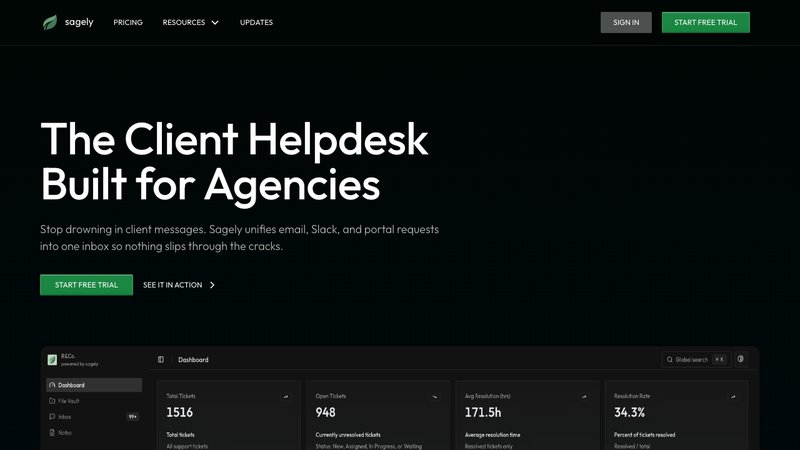
Sagely is what I wish existed when I was running my agency. It's a multi-client helpdesk that unifies tickets, time tracking, retainer management, file sharing, and client communication across Slack, email, and a self-serve portal. Everything is organized around the client, not the project.
What it does well: The Slack integration is genuinely useful. Your team can create tickets from Slack messages without leaving the conversation. The OTP client portal (passwordless, zero setup for clients) is low-friction. Built-in retainer tracking with overage models, rollover options, and real-time balance visibility. Flat pricing that doesn't punish you for adding team members.
Where it falls short: Sagely is newer to market, so integrations beyond Slack and email are still growing. If you need deep resource planning or profitability forecasting across a 50-person team, it's not built for that. It's purpose-built for the 1 to 15 person agency managing retainer clients.
Pricing: Solo $14.99/mo, Freelancer $29/mo (5 team members), Agency $79/mo (15 team members). 14-day free trial.
2. Teamwork.com: best advertising agency project management software for larger teams
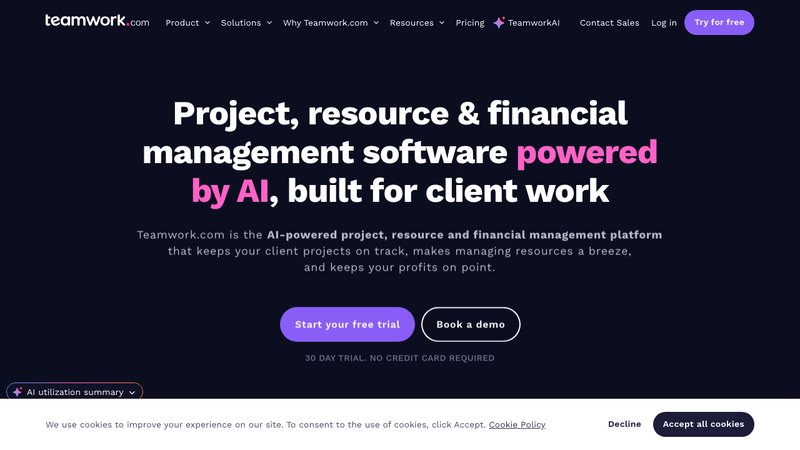
Teamwork is the most established player positioning itself for client work. It's really a project management platform with client features layered on top, plus a separate Desk product for ticketing. If you run an ad agency or advertising agency, their depth in project planning software for agencies is hard to beat.
What it does well: Deep project management (Gantt charts, dependencies, resource planning). Time tracking tied to budgets and profitability. Retainer management is available (in beta). Free tier for up to 5 users. Strong ad agency project management tool for teams that need financial visibility.
Where it falls short: Per-user pricing gets expensive fast. At $19.99/user/month on the Grow plan with a 5-user minimum, you're looking at $100/month before you've added anyone. The client portal and ticketing are separate products, not unified. Setup is more complex than agency-first tools.
Pricing: Free (5 users), Deliver $10.99/user/mo, Grow $19.99/user/mo, Scale and Enterprise custom.
3. ManyRequests: best creative agency software for design teams
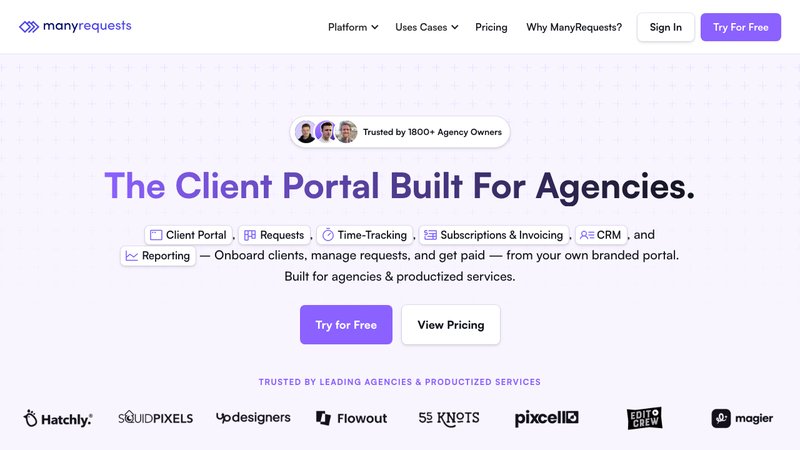
If you're searching for the best project management software for creative agency work, ManyRequests is worth a look. They've built a strong reputation as creative agency project management software for teams that run productized design services. Their client portal and creative project tracking software are polished.
What it does well: Client portal with custom domain branding. Design and video proofing built in (a key creative management tool most competitors skip). Time tracking with client breakdowns. Subscription and retainer billing. Over 1,800 agencies use it.
Where it falls short: Per-seat pricing on top of the base fee ($20 to $30 per extra seat). Slack integration is Pro-only ($99/mo). The "Powered by ManyRequests" badge can't be removed on the Core plan.
Pricing: Core $59/mo (1 seat), Pro $99/mo (1 seat), Enterprise $1,000+/mo. Annual plans save 20%.
4. Agency Handy: best for agencies selling productized services
Agency Handy positions itself as the all-in-one client portal for agencies that package their services as products. Their marketing highlights the consolidation angle: replacing $221/month in separate tools with one $29/month platform.
What it does well: Full white-label client portal with custom domain and branded login. CRM with leads pipeline. Invoicing and subscription management. Custom intake forms. Proposal creation.
Where it falls short: The $29/mo tier limits you to 1 user and 10GB storage. To get Slack integration and deeper features, you need the $99/mo or $199/mo plans. The client portal is more form-based than conversation-based.
Pricing: Freelancer $29/mo (1 user), Team Starter $99/mo (10 users), Business Pro $199/mo (30 users).
5. Wayfront (formerly SPP.co): best for service-based client portals
Wayfront (rebranded from Service Provider Pro) has been in the agency portal space since 2014. They're the OG of the category.
What it does well: Client portal, billing, order management, helpdesk, and CRM in one. Long track record in the space. Built specifically for service businesses.
Where it falls short: No built-in time tracking. The interface feels dated compared to newer competitors. Feature depth is thinner than tools that launched more recently.
Pricing: Starting around $20/mo, higher tiers at $50/mo and $300 to $500/mo.
6. Productive.io: best for resource planning at larger agencies
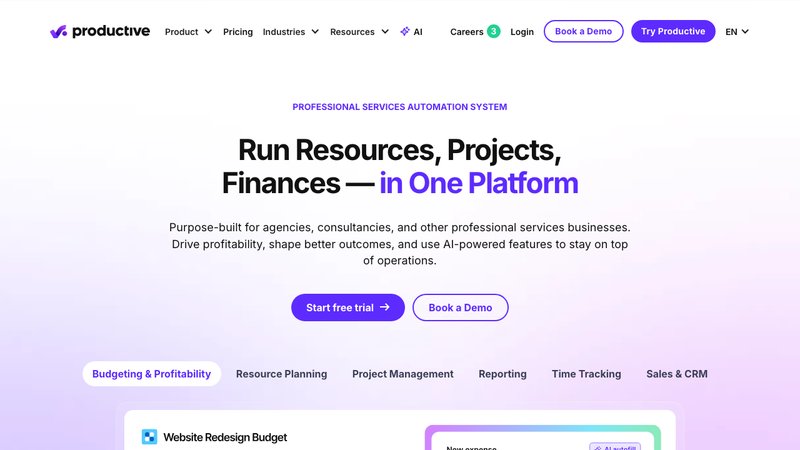
Productive is a professional services automation (PSA) tool. Think of it as Teamwork's more enterprise-focused cousin, built for agencies that need detailed resource planning and profitability tracking.
What it does well: Resource planning and forecasting. Budget tracking and profitability per project. Strong reporting and analytics.
Where it falls short:No client-facing portal. Per-user pricing. More complexity than most small agencies need. Better suited for 20+ person teams. If project management for agencies is all you need, this is overkill. Not the best project management software for digital agencies under 15 people.
Pricing: Per user/month (exact pricing requires demo).
7. Moxie (formerly Hectic): best for freelancers and micro-agencies
Moxie is the most affordable entry point in the category. It's built for freelancers first, with agency features added on.
What it does well: Proposals, contracts, and invoicing in one place. Meeting scheduler, calendar, and client portal. AI assistant for common tasks. Starts at just $10/month.
Where it falls short: Limited team collaboration features. The client portal and support ticketing are only available on Pro ($20/mo) and above. Not built for the multi-client, multi-team-member workflow that agencies need. Better for solo operators managing a handful of clients.
Pricing: Starter $10/mo, Pro $20/mo, Teams $32/mo (annual billing).
Agency management software: feature comparison
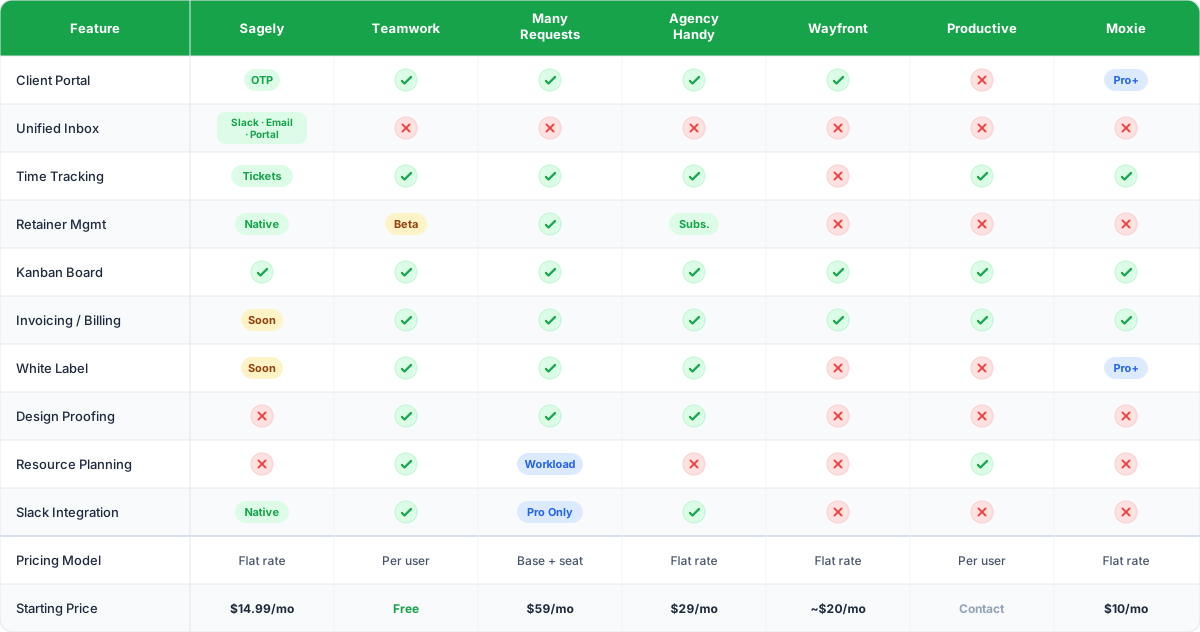
How to pick the right tool (a decision framework)
Don't start with the tool. Start with your biggest pain point. The best creative management software for your studio is different from the best digital agency software for a dev shop, which is different from the best ad agency project software for a media buyer. Context matters more than feature lists.
- "I can't keep track of client requests across Slack and email." Look at Sagely or ManyRequests. Both are built around request and ticket management as the core workflow.
- "I need to track profitability per project and plan resources." Look at Teamwork or Productive. They're built for that depth of financial visibility.
- "I sell productized services and need a client-facing order system." Look at Agency Handy or Wayfront. Their portal and order management flows are tailored for that model.
- "I run a creative agency and need workflow management." ManyRequests is the strongest creative agency workflow software in this list. If you need creative workflow management software with design proofing and project management tools for creative agencies, that's where to start.
- "I'm a solo freelancer and just need the basics." Look at Moxie. It's $10/month and covers proposals, contracts, invoicing, and basic creative management software.
- "I need retainer tracking that actually works." Your options are narrow: Sagely (native), ManyRequests (built-in), Agency Handy (subscription model), or Teamwork (beta). Everything else means spreadsheets. And we've already covered why that's a bad idea.
The first step isn't buying software
I know I've spent this entire article talking about tools and features and pricing. But here's my honest advice: don't start by shopping for agency management software.
Start by writing down where you're bleeding time.
Is it client communication? You're answering the same "what's the status?" question five times a week per client.
Is it time tracking? You're reconstructing your hours from memory every Friday afternoon.
Is it billing? You're dreading the monthly invoice because you know it's going to trigger a "can we hop on a call?" response.
Is it onboarding? Every new client setup takes a full day of back-and-forth before any real work begins.
Pick the one that hurts the most. Then find a tool that solves that specific problem well. Not the tool with the most features. Not the tool with the best marketing. The one that fixes your biggest bottleneck.
And if you discover that your biggest bottleneck is the disconnection between all these activities (the communication that doesn't connect to the time tracking that doesn't connect to the retainer that doesn't connect to the billing), then you don't need another point solution.
You need a unified system.
That's the fundamental shift. Not more tools. Better systems.
The agencies that figure this out stop drowning in admin, stop losing money to un-billed hours, and start actually enjoying the work again. And that's the whole point, isn't it? You didn't start an agency to spend your days managing spreadsheets. You started it to do great work for clients who value it.
Go fix the system. The work will follow.
FAQ: Agency management software
What is agency management software?
Agency management software is a platform that combines client communication, project tracking, time logging, and billing into one system built for agencies. Instead of using separate tools for each function, it connects everything around the client relationship so nothing falls through the cracks.
How is agency management software different from project management tools?
Project management tools (like Asana, Monday, or ClickUp) are designed to track tasks and deadlines for internal teams. Agency management software adds client-facing features: portals, retainer tracking, multi-channel communication, and invoicing. It's organized around the client, not the project. That's true whether you call it creative agency software, digital agency software, or marketing agency management software. For a deeper look at how agency project management works differently, I wrote a full breakdown.
Do agencies need a client portal?
Short answer: yes. A client portal gives your clients self-serve access to check project status, submit requests, and view retainer usage without emailing or Slacking you. It reduces interruptions, builds trust, and makes you look more professional. Every major agency management platform now includes one. Read more about client onboarding to see how portals fit into the broader workflow.
How much does agency management software cost?
Prices range from $10/month (Moxie, freelancer-focused) to $100+/month (Teamwork, per-user pricing for teams). Agency-first tools with flat-rate pricing (Sagely at $14.99 to $79/mo, Agency Handy at $29 to $199/mo) tend to be more predictable for small teams than per-user models.
What features should I look for in agency management software?
Start with whatever solves your biggest pain point. That said, the features that matter most for retainer-based agencies are: unified inbox (Slack + email + portal in one view), time tracking tied to tickets, retainer management with overage handling, a client portal, and flat-rate pricing. For a deeper look at optimizing your tool stack.
Can I replace my spreadsheets with agency management software?
That's literally the point. If you're tracking retainer hours, client requests, or billing in spreadsheets, you're spending hours on work that should be automated. The spreadsheet tax is real, and it compounds every month you put off switching.
What's the best agency management software for small teams?
For solo freelancers, Moxie ($10/mo) covers the basics. For 1 to 5 person agencies, Sagely's Freelancer plan ($29/mo) or Agency Handy ($29/mo) are strong starting points. For 5 to 15 person agencies, Sagely's Agency plan ($79/mo) or ManyRequests Pro ($99/mo) offer the depth you need. For agencies above 15 people, Teamwork or Productive are better fits.
What's the best project management software for creative agencies vs. digital agencies?
Creative agencies doing design, branding, or video work should look at ManyRequests (built-in design proofing and creative project tracking software) or Sagely (unified communication). Digital agencies focused on dev, SEO, or marketing campaigns should look at Sagely (Slack-native, ticket-based) or Teamwork (resource planning, profitability). The best project management software for creative agency work tends to prioritize visual proofing and client approvals. The best project management software for digital agencies tends to prioritize time tracking and retainer management.