


Request management for agencies is the system of capturing, organizing, and tracking client requests that come in across email, Slack, phone, and other channels into a single source of truth. Without it, requests slip through cracks, clients lose trust, and you spend more time managing the work than doing it.
You open your laptop on Monday morning and it starts immediately.
A client emailed a revision request over the weekend. Another one left a comment in a Google Doc at some point on Friday that you never saw. There's a Slack message from your biggest account, timestamped 11:47pm Sunday, that says "quick question" followed by four paragraphs and a screenshot. And your phone has a voicemail from a client who "just wanted to flag something small" that, you already know, is not small.
It's 8:15am and you're already behind.
As I walked through in piece on agency project management, this is the part of agency work that makes people rethink their career choices. Not the creative work. Not the strategy. The relentless stream of requests flying in from every direction, on every platform, at every hour. And the sinking feeling that you've definitely forgotten something but you have no idea what.
Here's the thing nobody tells you when you start an agency: the requests are the job. The designs, the campaigns, the code, that's the easy part. Managing the avalanche of asks, changes, follow-ups, and "one more things" is what actually determines whether you drown or stay afloat.
Why multi-channel client communication creates chaos
Agency requests scatter across email, Slack, WhatsApp, Google Docs, Loom, phone calls, texts, and Figma comments. Let's be specific about what we're dealing with here. Because "managing client requests" sounds manageable until you map out where those requests actually come from.
Email. Slack. WhatsApp. Google Doc comments. Loom videos dropped into a shared drive. Phone calls you forgot to take notes on. Text messages at 9pm. Comments on a Figma file. A verbal aside during a Zoom call that the client absolutely considers a formal request.
Now multiply that by five or eight clients, each with their own preferred communication channel, their own assumptions about response time, and their own definition of what counts as a "small tweak."
McKinsey found that workers spend 28% of their workweek managing email alone. That's roughly 2.6 hours a day, just on email. Then add another 20% of work time spent looking for information or tracking down colleagues who might have the answer. That's nearly half your week eaten up by emails and tracking down information before you've done a single hour of billable work.
For agency operators, those numbers are probably conservative. You're not managing one communication stream. You're managing dozens, across multiple clients, with no unified system tying them together. Every channel is an island. And requests are drowning between them.
I've talked to agency owners who keep a mental list of active requests. They just remember. Until they don't. And when they don't, it's always the worst possible request to forget: the one the client mentioned once, casually, in a channel you don't check often, that they now consider overdue.
That silence after a missed request? That's the beginning of a trust problem you might not recover from.
Why traditional ticketing tools fail small agencies
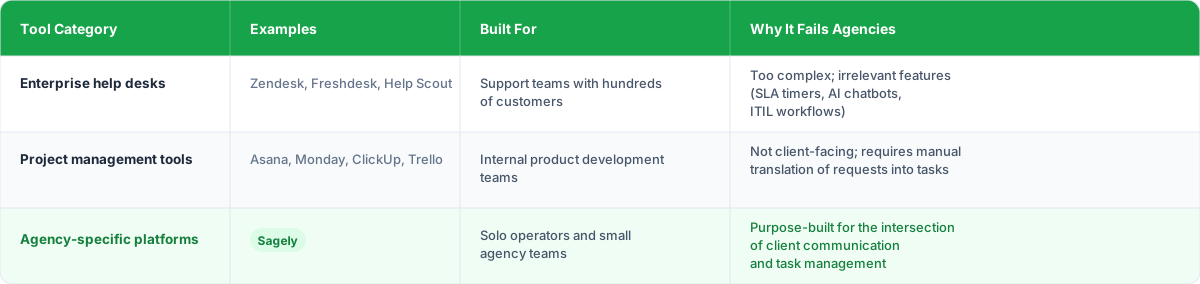
Most ticketing and request management systems fall into two categories, and neither one works for small agencies. Here's why Googling "best ticketing system" at 11pm after missing a client request doesn't solve anything.
- Category one: enterprise help desks.Zendesk. Freshdesk. Help Scout. These tools are built for customer support teams at companies with hundreds or thousands of customers. They're designed around SLA timers, agent queues, macros for repetitive support tickets, and CSAT surveys. If you're running a three-person agency with eight retainer clients, these tools are absurdly complex. You'll spend more time configuring the system than using it. And you'll be paying for features (ITIL workflows, AI chatbots, multi-tier escalation paths) that have zero relevance to your work.
- Category two: project management tools. Asana. Monday. ClickUp. Trello. These are built for internal teams managing product development cycles. They're great at organizing tasks into sprints, tracking project timelines, and assigning work to team members. But they weren't designed to be client-facing. When a client emails you a revision, you have to manually create a task, copy the details over, assign it, set a due date, and hope you captured everything. That translation step is where things die. It's friction. And friction kills systems.
According to Zylo's 2025 report, the average company now manages 305 SaaS applications, and 46% of those licenses go wasted. Meanwhile, Productiv found that only 30% of employees feel they have the correct tools for their work. Hundreds of tools, and most people still feel underserved. The issue isn't quantity — it's fit.
The issue for agencies is that you need something that sits in the intersection of client communication and task management. Something that captures requests from the channels your clients already use, without asking them to change their behavior, and organizes those requests into a system you can actually work from. That tool barely existed until recently.
How to build a request intake system that doesn't rely on your memory
The solution to scattered client requests isn't "just be more organized." If discipline alone worked, you'd have fixed this already. The core problem is simple: requests come in through channels you don't control.
You can't prevent a client from sending a Slack message or dropping a Google Doc comment. You can (and should) ask them to use a preferred channel, but we both know how long that lasts. Two weeks, tops, before they're back to texting you at dinner.
So instead of controlling the input, you need to control the capture.
- Step one: accept that clients won't change. This is the hardest part. You want to believe that if you just set up a nice intake form or send that "please submit all requests via email" message, clients will comply. Some will. Most won't. Build your system around that reality.
- Step two: establish a single capture point. Every request, regardless of where it originated, gets logged in one place. One. Not a spreadsheet and a Trello board. Not an email folder and a Slack channel. One system. When a client calls you with a request, you log it there before you hang up. When a Google Doc comment comes in, you turn it into an entry. When the Slack message arrives, same thing.
- Step three: make capture faster than remembering. This is the design principle that separates systems that stick from systems you abandon in two weeks. If logging a request takes longer than just keeping it in your head, you won't do it. The capture has to be nearly instant. A quick entry. A forwarded email. A two-click ticket creation. Anything more than that and your brain will default to "I'll remember it," which, as we've already established, is a lie you tell yourself.
- Step four: assign a sense of order. Once requests are captured, they need at minimum three things: which client, what's the ask, and when does it matter. You don't need complex priority matrices or weighted scoring systems. You need "Client A wants the homepage header changed by Thursday." That's it. If you can see all of those at a glance, you can make decisions about your day.
This is what McKinsey was pointing at when they reported that social and collaboration technologies could reduce time spent searching for information by 35% and raise knowledge worker productivity by 20 to 25%. It's not the technology itself that creates the lift. It's the elimination of the searching, the remembering, the "wait, what did they ask for again?" That's where the productivity is buried.
What is a single source of truth for client requests?
A single source of truth is one centralized system where every client request lives, regardless of which channel it came from, where you can see what's pending, what's in progress, and what's done. I need to tell you a story, because it's the reason this topic hits close to home.
When I ran a solo agency, keeping track of client requests through Slack, email, and conversations became an impossible task. At first, I was just happy to be productive and hopefully doing great work. Then deadlines started to slip. Threads became impossible to track. Change requests lived on different platforms, comments added on different threads. Keeping up with all the different channels became part-time work on top of my already full-time job as an agency operator.
I tried using spreadsheets, Asana, Monday, and Trello. All worked for a time. But I needed a system that worked with solo or small team agency workflows. I looked at different ticketing platforms like Freshdesk and Help Scout, but they were too focused on enterprise or bulky IT-related features. Paying for a platform that wasn't meant for agency workflows felt like paying for a car that I could only drive on certain days of the week.
That frustration is ultimately why Sagely exists. A unified inbox that pulls in Slack, email, and portal messages into one place. A ticketing system with Kanban, built for client work, not IT support queues. Time tracking tied directly to tickets so you're not switching apps. A client portal where clients can see their requests and send new ones without needing to remember a password (just a one-time code). It was built because the tool I needed didn't exist, and I got tired of duct-taping three platforms together to do the job of one.
But here's the point: the tool only works because the system underneath it is sound. The whole thing comes down to a single source of truth. One place where every client request lives, regardless of where it originated. Where you can see what's pending, what's in progress, and what's done. Where the client can check status instead of sending you "just checking in" messages.
When you have that single source of truth, several things happen. You stop spending 20% of your day looking for information, because it's all in one place. You stop missing requests, because they're captured as they come in. You stop getting blindsided by "didn't you see my message?" because you have a system that doesn't rely on you manually checking six different apps.
As we explored in our thinking on client relationship management, the relationship is the business. And nothing damages a relationship faster than a client feeling forgotten. A single source of truth is how you make sure that doesn't happen.
How to switch from reactive to proactive request management
Proactive request management means batching responses at set times, giving clients self-serve visibility into status, identifying recurring request patterns, and templating common replies. Most agency operators live in reactive mode.
A request comes in, you respond. Another one comes in, you respond. You're a pinball bouncing between client asks all day, and by 5pm you realize you haven't done a single hour of deep work.
Atlassian's 2024 research paints the picture clearly: 72% of meetings are ineffective, 78% of employees say too many meetings make it hard to get actual work done, and 54% leave meetings without clear next steps. Now layer agency life on top of that. You're not just dealing with internal meetings. You're fielding client calls, status updates, revision discussions, and "quick syncs" that could have been an email.
Reactive mode is the default because it feels productive. You're responding. You're busy. But busyness is not productivity, and responding to requests as they arrive is one of the least efficient ways to manage them.
Here's how you flip from reactive to proactive:
- Batch your responses. Set specific times for reviewing and responding to client requests. Morning, after lunch, end of day. Between those windows, you do the actual work. Batching requests gives clients a better version of you — focused and deliberate instead of scattered and constantly context-switching.
- Give clients visibility before they ask. Most "just checking in" messages exist because the client has no idea what's happening with their request. Give them visibility. A shared board. A client portal. A weekly status update. When clients can see the status themselves, the interruptions drop dramatically.
- Identify request patterns. After a few weeks of capturing requests properly, you'll start to see patterns. Client A always has copy revisions on Mondays. Client B dumps a batch of design requests after their team meeting every other Wednesday. When you can anticipate requests before they arrive, you can schedule capacity for them. That's proactive. That's running an agency instead of letting the agency run you.
- Use canned responses for recurring asks. If you answer the same types of questions or acknowledge the same types of requests repeatedly, template those responses. Starter templates you can personalize in 30 seconds instead of typing from scratch every time. This alone can save hours per week.
The math here matters. Grammarly estimates that miscommunication costs $9,284 per employee per year. Fierce Inc. found that 86% of executives cite ineffective communication as the primary reason for workplace failures. And Asana reported that 55% of workers at highly collaborative organizations saw revenue growth. Communication isn't a soft skill. It's an operational system. And proactive request management is how you run it.
How to scale request management without hiring more people
You scale request management through systems, not headcount: automatic request capture, visual prioritization, integrated time tracking, and client-facing status portals. Here's where this conversation gets real for small agencies.
You're probably running lean. Maybe it's just you. Maybe you have one or two contractors. According to SmallBizGenius, 19% of small business owners work over 60 hours a week. You're already maxed out. The answer to "I have too many requests" can't be "hire more people." At least not yet.
The answer is systems that scale better than your memory does.
When you're handling three clients, you can keep everything in your head. Maybe. When you're handling six or eight, that stops working entirely. And the gap between "I can manage this" and "things are falling through the cracks" is smaller than you think. One new client can push you from organized to overwhelmed in a week.
A proper request management system lets you scale your capacity without scaling your hours. Here's what that looks like in practice:
- Requests are captured automatically. Emails forwarded to a unified inbox. Slack messages routed to a central system. Client portal submissions that create tickets without you lifting a finger. The less manual data entry, the more sustainable the system is.
- Prioritization is visual and instant. A Kanban board, a priority list, whatever works for you. The point is that you can glance at your workload and know immediately what needs attention today versus what can wait. No digging through email threads. No scrolling through Slack channels.
- Time tracking is baked in, not bolted on. As I covered in depth in [the piece on time tracking](/blog/time-tracking-without-the-pain), the moment time tracking lives in a separate tool, you stop doing it. When it's attached directly to the request or ticket you're working on, it becomes part of closing out the task instead of an extra chore you skip.
- Clients have a window into the system. Not full admin access. Just enough to see their requests, submit new ones, and check status without pinging you. This is the single biggest time-saver most agency operators overlook. When clients can self-serve on status updates, your inbox gets quieter and your relationships get better. Nobody likes chasing their own vendor for updates.
With Parakeeto reporting that agencies lose 10 to 20% of gross margin to non-billable time, and the average agency net margin sitting around 10%, every hour you spend on request management overhead is an hour eating directly into your profit. The system has to be so lightweight, so embedded in your workflow, that using it costs you less time than not using it.
Your requests are your business. Treat them that way.
Here's what I've learned the hard way: agencies don't fail because the work is bad. They fail because the work around the work buries them. The requests, the follow-ups, the constant context-switching between seven different apps just to figure out what you're supposed to be working on right now.
Every missed request is a trust dent. Every "sorry, that fell through the cracks" is a tiny withdrawal from the relationship bank. Do it enough times and the client leaves, usually without telling you why. They just stop renewing.
The fix isn't working harder. You're already working hard. The fix is building a system that catches everything, shows you what matters, and gets out of your way so you can do the work you actually started this agency to do.
Start simple. Capture everything in one place. Batch your responses. Give clients visibility. Track your time against the requests, not in a separate universe. And if you've outgrown spreadsheets and bolted-together tools, take a look at Sagely. It exists because I lived this exact problem and got tired of solving it with duct tape.
Your requests are your business. Literally. Treat them like it.
Frequently asked questions about agency request management
What is request management for agencies?
Request management for agencies is the process of capturing, organizing, tracking, and completing client requests that arrive across multiple channels like email, Slack, phone calls, and messaging apps. A proper system creates a single source of truth where every request lives, so nothing falls through the cracks.
Why do traditional ticketing systems fail small agencies?
Enterprise help desks (Zendesk, Freshdesk) are built for support teams with hundreds or thousands of customers, not small agencies with eight retainer clients. Project management tools (Asana, Monday) aren't client-facing and require manual translation of requests into tasks. Neither category fits the small agency workflow.
How do I build a request intake system for my agency?
Accept that clients won't change their communication habits. Establish one capture point for all requests regardless of channel. Make capturing a request faster than memorizing it. Then assign each request a client, a description, and a deadline. The system must be simpler than your memory or you'll abandon it.
What is a single source of truth for client requests?
A single source of truth is one centralized system where every client request lives, regardless of which channel it came from. It shows what's pending, in progress, and done. Clients can check status without messaging you, and you stop spending 20% of your day hunting for information across multiple apps.
How do agencies switch from reactive to proactive request management?
Batch your responses at set times instead of answering instantly. Give clients visibility into request status through a portal or shared board. Identify recurring request patterns so you can schedule capacity in advance. Template common responses to save hours per week. This shifts you from firefighting to intentional work.
How can a solo agency operator manage more clients without hiring?
Use systems that capture requests automatically (unified inbox, client portal), provide visual prioritization (Kanban boards), integrate time tracking directly with tasks, and give clients self-serve status visibility. These systems scale your capacity without scaling your hours or headcount.
How much time do agencies waste on non-billable request management?
According to McKinsey, workers spend 28% of their workweek on email and another 20% searching for information. Parakeeto reports agencies lose 10 to 20% of gross margin to non-billable time. With average agency net margins around 10%, every hour spent on manual request management overhead eats directly into profit.