


Tool stack optimization is the process of auditing, consolidating, and reducing your agency's software subscriptions so you're paying only for tools you actually use. The average company manages 305 SaaS applications (Zylo, 2025), with 46% of those licenses going wasted. For agencies running on 10% net margins, every unused subscription eats directly into profit.
Here's how most agency tool stacks are born. Not through strategy. Through panic.
You miss a deadline, so you sign up for a project management tool. A client disputes your hours, so you grab a time tracker. Communication gets messy, so you add a Slack workspace. Then a shared drive. Then a proposal tool. Then something for contracts. Then something for invoicing that doesn't quite talk to the thing you use for contracts.
Six months later, you've got fourteen subscriptions, a dozen logins you cycle through daily, and a creeping suspicion that you're spending more time managing your tools than doing actual client work. Your credit card statement looks like a SaaS company's customer list.
As I laid out in on agency project management, this is an industry-wide pattern. And the numbers are worse than you'd expect.
Why do agencies accumulate too many tools?
Agencies accumulate tools reactively, emotionally, and without auditing what they already have. Every tool was the solution to a specific pain point at a specific moment, but nobody goes back to ask if it's still needed. The scale of this problem is hard to believe until you see the data.
According to Zylo's 2025 SaaS Management Report, the average company manages 305 SaaS applications. Productiv's 2024 data puts it even higher at 342 apps per organization. The worst part: 46% of those SaaS licenses go completely wasted. Not underused. Wasted. Nearly half.
Now, you're not running a Fortune 500 company. You're running a three-person agency. But the psychology is exactly the same. You accumulate tools the same way enterprises do: reactively, emotionally, and without auditing what you already have.
Every tool you've ever signed up for was the solution to a specific pain point at a specific moment. But nobody goes back and asks, "Is this still solving that problem? Was there a cheaper way? Am I even logging into this thing anymore?"
Productiv found that only 45% of users across SaaS apps are actually engaged. That means 55% of the people (or in your case, the subscriptions) are just sitting there. Burning money.
Month after month.
And 39% of employees use apps that aren't even managed by their company. In a small agency, that looks like the random Canva Pro subscription one contractor set up, the Notion workspace you created for one project and forgot about, or the AI writing tool someone on your team is expensing that you didn't even know existed.
Zylo found that 77% of IT leaders had no idea their teams were using AI apps. If that's happening at companies with entire IT departments, imagine what's lurking in your credit card statements.
The pattern is always the same: buy on panic, forget to cancel, repeat.
What is the real cost of tool sprawl for agencies?
Tool sprawl costs agencies far more than subscription fees. The real costs are context-switching between apps, acting as the manual integration layer between tools, maintaining and updating software, and scattered information that causes missed client requests. Here's where this gets painful. Because the subscription fees are just the line item you can see. The real cost is everything underneath.
Let's start with the obvious number. Zylo reports that 52% of organizations overspent their SaaS budgets in the past year. And 61% were forced to cut actual projects because of unplanned SaaS cost increases. Think about that. Agencies cutting deliverables or delaying hiring because their software bill crept up without anyone noticing. When 79% of leaders encountered price increases at SaaS renewal, you can bet those "just $10 more a month" bumps are compounding into something ugly.
But the subscription cost is actually the smallest problem. Nobody talks about these.
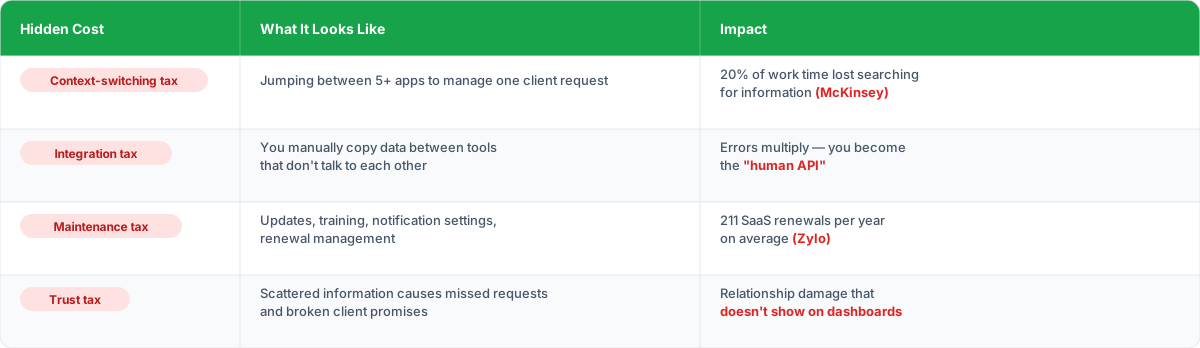
- The context-switching tax. Every time you switch between tools, your brain pays a toll. You check email for client requests, then open Slack, then jump to your project board, then open your time tracker, then flip to your invoicing app. Each switch costs you focus. McKinsey found that 20% of work time is spent just looking for information or tracking down people who have it. When your information lives across eight different platforms, that number gets worse. Much worse.
- The integration tax. Your tools don't talk to each other. So you become the integration layer. You copy a client request from email into Asana. You manually transfer time entries from Toggl into your invoice in QuickBooks. You screenshot a conversation from Slack to attach to a task in ClickUp. You are the human API. And human APIs make errors, get tired, and deeply resent the work.
- The maintenance tax. Every tool needs managing. Updates, new features that rearrange the interface, team members who need training, notification settings that need configuring. Zylo found that organizations manage 211 SaaS renewals annually. Even at a fraction of that, you're spending real hours every year just keeping your tools current and your subscriptions from auto-renewing at higher rates.
- The trust tax. When information is scattered, things fall through cracks. And when things fall through cracks, clients notice. As I covered in the piece on request management, a missed request because it came through a channel you forgot to check starts a trust problem that's hard to come back from. And when your time tracking lives in a separate tool from your work, you stop logging altogether. That's how billing disputes start, the kind that torpedo client relationships.
For an agency running 10% net profit margins (Parakeeto, 2024), these hidden costs aren't minor. They can break you. You can't afford inefficiency when your margin is that thin.
How to audit your agency's tool stack
A tool stack audit takes about an hour and usually saves hundreds of dollars a month. Follow these five steps: dump all recurring charges, test when you last logged in, check for functional overlap, evaluate if each tool fits your team size, and identify consolidation opportunities. I've got a framework for cleaning up your stack that I've used myself and walked other agency operators through.
- Step one: the subscription dump. Open your credit card and bank statements for the last three months. List every single recurring software charge. Every one. Include the ones you forgot about. Especially those. This exercise alone is usually enough to trigger a minor existential crisis.
- Step two: the login test. For each tool on your list, answer one question honestly: when was the last time you logged in? Not "when was the last time you could have logged in." When did you actually use it? If the answer is more than 30 days ago, flag it.
- Step three: the overlap check. Map each tool to the job it does. You'll almost certainly find overlap. Two tools that handle messaging. A project board and a spreadsheet tracking the same tasks. A time tracker and an invoicing tool that both have time tracking built in. Overlap means you're paying twice for the same capability, and probably using neither one well.
- Step four: the "who is this built for?" filter. This is the one most people skip, and it matters. Look at every tool on your list and ask: was this built for a team my size? If you're a solo operator using software designed for 50-person product teams, you're paying for complexity you'll never touch. Only 30% of employees feel they have the correct tools for their work (Productiv, 2024). A big reason is that people adopt tools built for someone else's problems.
- Step five: the consolidation question. For every essential function, ask: can fewer tools do this? Can one platform handle client communication and request tracking and time logging? If yes, consolidate. Every tool you eliminate is one less login, one less integration to maintain, and one less place for information to hide.
What to cut immediately:
- Any tool you haven't logged into in 30+ days
- Any tool that duplicates a function another tool already handles
- Any "nice to have" dashboard or reporting tool you could replace with a simple document
- Any communication tool your clients don't actually use
- Any tool where you're paying for 50 seats but using 3
- Any standalone spreadsheet setup that a purpose-built tool already replaces (more on outgrowing spreadsheets here)
What tools does an agency actually need?
Most agencies under ten people need four functions: client request management and communication, integrated time tracking, proposals and contracts, and accounting. That's three to four tools total, costing $55 to $144 per month. After the audit, you should be down to the tools you genuinely need. For most agencies under ten people, that list is shorter than you'd expect.
Client request management and communication
This is the center of your operation. One place where client requests land, where communication happens, where files live, and where approvals are tracked. Not email plus Slack plus a Google Drive plus a project board.
One place.
This is where a purpose-built platform like Sagely fits. It combines client communication, request ticketing, and file sharing into a single workspace designed for solo operators and small agencies. Per-plan pricing, not per-seat, which matters when every hire doesn't need to double your software bill.
Time tracking (integrated, not separate)
As I covered in the piece on time tracking, the number one reason agencies don't track time accurately is that the tracker lives in a completely different app from the work.
When you have to stop what you're doing, open a separate tool, find the right project, start a timer, then switch back, you skip it. Every time.
Time tracking should be embedded in whatever system handles your client work. Not bolted on. Built in. Sagely includes this alongside your requests and communication, which eliminates the context switch that kills logging habits.
Proposals and contracts
PandaDoc, Proposify, or something similar. You need to send professional proposals and get contracts signed digitally. Pick one, learn it, stick with it. Budget $25-35/month.
- Accounting. QuickBooks, Wave, or FreshBooks. Invoicing, expense tracking, tax prep. You need this. Budget $15-30/month.
- That's it. Four functions. Three to four tools (fewer if your client management platform handles time tracking and communication, which it should).
Monthly breakdown:
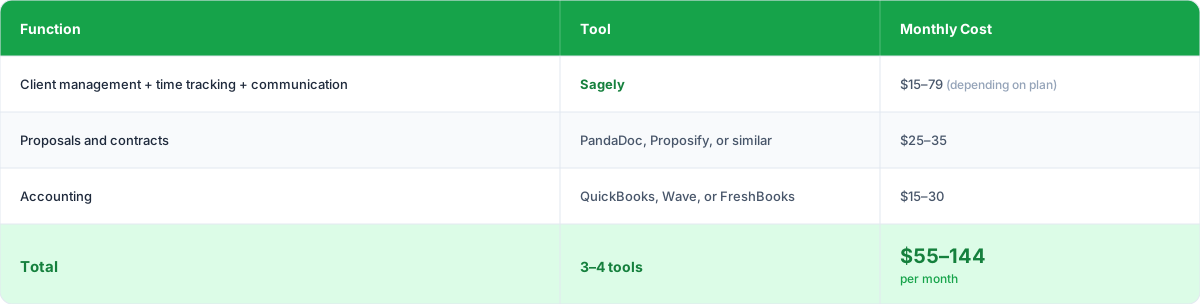
Compare that to the agency operators I've talked to who are spending $400, $500, sometimes $700/month across a dozen subscriptions, half of which they barely touch. When 19% of small business owners already work 60+ hours a week and 89% work weekends (SmallBizGenius), you don't need your software stack piling on.
Why consolidation beats collection for agency tools
Every tool decision should follow one principle: consolidation beats collection. The instinct when something breaks is to add a tool. Resist it. The better question is always: can an existing tool handle this? One principle should guide every tool decision you make: consolidation beats collection.
Every time.
The instinct when something breaks is to add a tool. Resist it. The better question is always: can an existing tool handle this? Or can I replace two existing tools with one that covers both?
McKinsey found that collaboration technologies could raise knowledge worker productivity by 20 to 25%. But that gain only shows up when the tools reduce complexity instead of adding to it. Ten tools that each do one thing well still create nine integration gaps.
Two tools that cover the same ground with fewer handoffs will almost always outperform the "best of breed" approach at the small agency level.
I've seen this play out dozens of times. The agency using Slack for communication, Asana for task management, Toggl for time tracking, Google Drive for files, and email for client requests. Five tools. Five places where information lives.
Five places where things get lost. And the agency operator in the middle, acting as the human glue holding it all together.
That operator could be doing billable work instead. At the average agency billing rate, even reclaiming a few hours a week from tool management pays for the consolidation many times over.
94% of leaders believe that manual SaaS management leads to poor decisions (Productiv, 2024). At enterprise scale, that means dedicated SaaS management platforms. At agency scale, it means something much simpler: pick fewer tools, make them work together, and stop treating every new problem as an excuse to add another subscription.
How to keep your agency tool stack lean over time
Set a monthly cost ceiling of $150 to $200, do quarterly subscription reviews, apply a 48-hour rule before buying new tools, and track the real cost including your time, not just the sticker price. The audit isn't a one-time exercise. Tool sprawl is like weeds. You pull them out, and they grow back. Here's how to keep your stack clean over time.
- Set a monthly cost ceiling. Your total tool spend should stay under $150-200/month for a small agency. Write that number down. Stick to it. When a new tool tempts you, something else has to go. That constraint forces better decisions.
- Do a quarterly subscription review. Every three months, repeat the login test. If you haven't used it in 90 days, cancel it. No "but I might need it someday." If you need it someday, you can sign up again someday. The sunk cost fallacy has no place in your P&L.
- Apply the 48-hour rule for new tools. When a pain point hits and you want to sign up for something, wait 48 hours. Most of the time, it's a process problem, not a tool problem. As I wrote in [the pillar piece](/blog/agency-project-management), a tool without a system is just software you're paying to not use. Fix the system first. If the problem persists after 48 hours of trying to solve it with process, then evaluate tools.
- Track the real cost, not just the sticker price.A $10/month tool that requires an hour of maintenance every week isn't cheap. It costs $10 plus four hours of your time. If you bill at $100/hour, that "$10 tool" actually costs $410/month. Factor in your time when evaluating any subscription.
- Default to fewer. When in doubt, don't add. The overhead of adding a tool (learning it, configuring it, integrating it, maintaining it, eventually migrating off it) almost always exceeds the initial estimate. 48% of SaaS expenditures are driven by business units outside IT control (Zylo, 2025). In a small agency, that "business unit" is you at midnight, frustrated, credit card in hand. Don't make subscription decisions at midnight.
Cut your stack this week
If you're spending more than $200/month on software, if you're logging into more than four or five tools a day, if you've got subscriptions you forgot you were paying for, it's time to cut.
The math is simple. Agency margins are thin. Every dollar you waste on unused software is a dollar that doesn't go toward hiring, growth, or the salary you actually deserve. Every hour you spend maintaining, switching between, and troubleshooting your tools is an hour you're not billing.
Fewer tools. Better systems. That's the entire philosophy.
Audit your stack this week. Cancel what you're not using. Consolidate where you can. Set a ceiling and hold yourself to it. And if you find that your client communication, request tracking, and time logging are scattered across three or four different apps, take a look at Sagely. It replaces 3 tools you're currently paying for, at a price that won't wreck your margins.
Stop collecting tools. Start building systems.
Frequently asked questions about agency tool stack optimization
How many SaaS tools does the average company use?
According to Zylo's 2025 SaaS Management Report, the average company manages 305 SaaS applications. Productiv's 2024 data puts it at 342 apps per organization. Nearly 46% of those licenses go completely wasted, meaning companies pay for tools nobody actually uses month after month.
What is tool sprawl and why does it hurt agencies?
Tool sprawl is the accumulation of software subscriptions acquired reactively to solve individual pain points, without ever auditing what you already have. It hurts agencies through subscription costs, context-switching between apps, manual integration work, maintenance overhead, and scattered information that causes missed requests.
How do I audit my agency's tool stack?
Run a five-step audit: dump all recurring charges from bank statements, test when you last logged into each tool, check for functional overlap between tools, evaluate whether each tool was built for your team size, and identify where fewer tools could cover the same ground. This takes about an hour and usually saves hundreds per month.
What tools does a small agency actually need?
Most agencies under ten people need four functions: client request management and communication (one platform), integrated time tracking, proposals and contracts, and accounting. That's three to four tools total, with a monthly cost between $55 and $144.
How much should an agency spend on software per month?
Keep total tool spend under $150 to $200 per month for a small agency. Set this as a hard ceiling and stick to it. When a new tool tempts you, something else must go. Compare this to the $400 to $700 many agency operators spend across a dozen barely-used subscriptions.
How often should I review my agency's tool stack?
Do a quarterly subscription review using the login test: if you haven't used a tool in 90 days, cancel it. Apply a 48-hour rule before buying new tools, since most pain points are process problems, not tool problems. Track the real cost including your time, not just the subscription price.