


Billing dispute prevention is the practice of building documentation and communication systems that stop invoice disagreements before they start. It covers scope agreements, approval workflows, real-time time tracking, and regular budget check-ins so you never have to argue about an invoice. Most billing disputes aren't billing problems. They're documentation problems.
"Client is refusing to pay invoice because they don't believe the hours."
"We sent the invoice, and the client is refusing to pay the overage. They claim we are inflating hours. We logged everything manually in Excel, so I have no proof other than my word."
You'll find posts like this every single week across Reddit, Facebook groups, and agency forums. Agency operators pouring out their frustration after getting stiffed on invoices they genuinely earned. The stories are all slightly different. The ending is always the same: they eat the hours, they lose the client, or both.
As I covered in piece on agency project management, I've been that person. A client disputed about 40 hours of revision work I'd done over three weeks. Every hour was real. But all I had was a spreadsheet filled in from memory the Friday before invoicing. I couldn't point to task logs, timestamps, or approval emails. I ate those hours to save the relationship.
That was expensive tuition. But it taught me something I've never forgotten: billing disputes aren't billing problems. They're documentation problems. And by the time you're arguing about an invoice, you've already lost.
This article is about making sure you never get to that argument in the first place.
Why do agencies have billing disputes?
Agency billing disputes happen because of documentation gaps, not dishonest clients. Here's the thing most agency owners get wrong about billing disputes. They think the client is being dishonest. Sometimes that's true. But more often, the client genuinely doesn't believe the number on the invoice. And the reason they don't believe it is because you gave them no reason to.
Think about it from the client's side. They hired you two months ago. You've been working away, sending the occasional update, maybe jumping on a call every couple of weeks. Then an invoice lands in their inbox with a number that's higher than they expected.
They have no visibility into what you did each day. No record of the dozen small change requests they made over Slack. No approval trail for the extra work they asked for in passing.
From their perspective, all they see is a number. And a number without context is just a guess.
The root causes are predictable:
- Vague scope of work. "Website design" means one thing to you and a completely different thing to the client. Without specifics, every conversation about what was "included" becomes a negotiation.
- No paper trail for changes. The client asks for "one quick tweak" on a call. You do it. Three more follow. By the end of the month, you've done 15 hours of un-scoped work with zero documentation.
- Retroactive time tracking. You log your hours from memory days after the work is done. Even you aren't confident in the numbers.
- No budget check-ins. The first time the client sees how many hours you've spent is when the invoice arrives. Surprise invoices breed disputes.
- Silent scope creep. You absorb extra work without flagging it because you don't want to seem difficult. Then you invoice for it and the client says, "I never approved that."
Every single one of these is preventable. Not with better clients. Not with better luck. With better systems.
How much do billing disputes actually cost your agency?
A single billing dispute can wipe out an entire month of agency profit. Let's talk numbers, because the damage goes way beyond the hours on that one invoice.
According to SmallBizGenius, 82% of businesses that fail do so because of cash flow problems. And only 40% of small businesses are profitable. Another 30% lose money, and 30% break even. When you're running an agency on the industry average net profit margin of about 10% (Parakeeto, 2024), a single disputed invoice can wipe out an entire month's profit.
But the invoice itself is the visible cost. The invisible costs are worse.
The time cost. You spend hours going back through emails, Slack threads, and your calendar trying to reconstruct a timeline of work. Hours you can't bill anyone for. According to Grammarly, miscommunication costs companies $9,284 per employee per year. A billing dispute is miscommunication with a dollar sign on it.
- The relationship cost. Even if you resolve the dispute, the trust is damaged. SuperOffice found that 1 in 3 customers will leave a brand they love after just one bad experience. A billing fight is about as bad as it gets. You might "win" the dispute and lose the client.
- The emotional cost. This one doesn't show up on any spreadsheet. Nineteen percent of small business owners already work over 60 hours a week, and 89% work weekends (SmallBizGenius). Adding a billing dispute on top of that workload creates the kind of stress that makes you question why you're doing this at all.
- The opportunity cost. Every hour you spend fighting over an invoice is an hour you're not spending on billable work, business development, or, you know, sleeping.
Freelancers Union's "World's Longest Invoice" campaign has collected over $12.6 million in reported unpaid bills from freelancers and independent workers. Twelve point six million. Those aren't research estimates — real people reported real money they worked for and never got paid.
The agencies that survive aren't the ones that win billing disputes. They're the ones that never have them.
How to write scope agreements that actually prevent disputes
Your scope of work document is either your best defense or your biggest liability. There's no middle ground. I said it in the pillar article, and now I'll say it with more detail. There's no middle ground.
Most scope documents fail because they're written like contracts: long, dense, full of legal language nobody reads. The client signs it because their lawyer said it was fine, then forgets everything in it by week two. When a dispute comes up, you point to section 4.2(b) and the client points to a conversation they had with you three weeks ago. Nobody wins.
Here's what actually works:
- Write it in plain English. Drop the legalese. Your scope document should read like a conversation. "Here's what we're doing. Here's what we're not doing. Here's what happens when you need something outside this list." If a reasonable person can't understand it in two minutes, rewrite it.
- Be specific about what's excluded. This is the part most agency owners skip, and it's the part that saves you. Don't just list what's included. Explicitly list what's not. "This scope includes up to three rounds of revisions on the homepage design. Additional rounds are billed at $X per hour." "This scope does not include copywriting. If you need copy, we can quote that separately." Exclusions eliminate ambiguity before it starts.
- Define what a "revision" means. This is a billing dispute waiting to happen if you leave it vague. Is changing a color a revision? Is rewriting the headline because the CEO didn't like it a revision? Spell it out. "A revision is a set of changes submitted together for a single deliverable. Each submission counts as one round, regardless of how many individual changes are included."
- Include a change request process. State clearly what happens when the client needs something that falls outside the scope. Who initiates it? How is it documented? How is it approved? This should be dead simple: "Any work outside this scope will be quoted separately and requires written approval before we begin."
The goal isn't to create a legal fortress. It's to create shared understanding. When both sides agree on what's included and what's not, there's nothing to argue about later.
How approval workflows kill billing disputes before they start
The approval email is the simplest technique that prevents the most billing disputes. Here's the technique I mentioned in the article about agency project management that I want to break down properly, because it's saved me more times than I can count.
The second you realize a project is going to exceed the original estimate, you stop and send a short, clear email to the client. Not a novel. Not an apology. Just the facts:
"Hi [Client], quick heads up. We've hit the upper end of the estimated hours for the homepage redesign. The additional revisions you requested on [date] and [date] have added roughly X hours. To complete the remaining changes, we're looking at an additional Y hours at our standard rate. Want us to proceed? Let me know and we'll keep rolling."
That's it. Three sentences. Takes five minutes to write. And it does three things at once:
- It gives the client a chance to say yes or no before you do the work.
- It creates a paper trail showing you communicated the overage before it happened.
- It eliminates the surprise factor that causes most disputes.
If the client says yes, you have documented approval. If they say no, you've avoided doing work you won't get paid for. Either way, the dispute dies before it's born.
Make this a habit, not an exception. The approval email shouldn't only happen when you're way over budget. Send it the moment you see the scope starting to stretch. Early warning beats late-invoice shock every single time.
And keep those approval emails somewhere you can find them. If they live in a thread you'll never locate again, they're useless when you need them six weeks later. This is where having your communication tied to the actual project (not buried in a generic inbox) makes all the difference.
Why proof of work beats proof of trust for agency billing
Trust doesn't pay invoices. Documentation does.
When a client says "I don't believe you worked that many hours," they're not calling you a liar. They're saying you haven't given them enough evidence. And the burden of proof is always on you, whether that's fair or not.
An HBR/AffinityLive study found that each professional services worker loses roughly $50,000 per year in revenue from insufficient time tracking. Not because the work isn't being done, but because it's not being documented.
People who track time daily are significantly more accurate than those who do it weekly. And about 40% of professionals report never tracking time spent on email, even though McKinsey estimates email takes 28% of the workweek.
I covered time tracking depth in a separate piece on tracking time without wanting to quit, but here's the billing-dispute-specific angle: your time entries need to be detailed enough to withstand scrutiny.
"Client A, 3 hours" won't survive a dispute. "Client A, homepage revision round 2, implemented feedback from 6/14 email, adjusted hero section layout and updated CTA copy per client request, 2.75 hours" will.
What proof of work actually looks like:
- Time entries logged in real time (or close to it), not reconstructed on Friday
- Each entry tied to a specific task, request, or ticket
- Client approvals documented alongside the work they approved
- Communication history preserved and searchable, not scattered across five apps
- Regular status updates that show the client what you've been working on
This is where your tools matter. If your time tracking lives in a spreadsheet disconnected from your client communication and task management, you're building proof with no foundation. When your time tracking is tied directly to client requests, with timestamps and an audit trail, you've got something concrete to point at.
Sagely was built specifically for this.
Time tracking tied to tickets, client-facing portals where they can see status, retainer tracking with overage alerts, and a documented communication history that lives alongside the work. Tools don't solve everything. But the right tool makes the system sustainable. Hard to dispute hours when every hour has a receipt.
How regular budget check-ins eliminate surprise invoices
The single most effective thing you can do to prevent billing disputes is embarrassingly simple: tell the client where they stand before the invoice arrives.
This means running a weekly or biweekly budget check-in. Not a formal meeting. Not a 30-minute call with an agenda. A quick update. An email. A message through whatever system you use to communicate. Something like:
"Hey [Client], quick budget update. We've used 32 of 40 hours this month. The remaining 8 hours are allocated to the landing page finalization and the email template. If anything changes, I'll flag it before we go over."
That's 60 seconds of your time. And it does more to prevent disputes than any contract clause ever will.
Here's why this works psychologically: when clients see their budget being consumed in real time, they self-regulate.
They stop sending "one quick thing" requests because they can see those requests have a cost. They prioritize. They think twice before asking for a third round of revisions. The budget becomes a shared constraint, not a surprise reveal.
And when the invoice does arrive, it's a non-event. They already knew what to expect. There's nothing to dispute because there's nothing unexpected.
Compare that to the alternative: the client hasn't heard from you about hours in three weeks. An invoice arrives showing 52 hours against a 40-hour estimate. They immediately feel blindsided. And blindsided clients dispute invoices. They feel like they lost control.
As I discussed in our piece on client relationship management, the relationship is the business. Regular budget transparency builds trust. It makes everything else easier, not just billing.
The system behind the systems
If you've read this far, you might be noticing a pattern. Every prevention system comes back to the same principle: document, communicate, confirm.
Document the scope. Communicate changes. Confirm approval before doing the work. Document the time. Communicate the budget status. Confirm the client knows what to expect on the invoice. It's the same three-step loop, applied at every stage.
The agencies that never deal with billing disputes aren't doing anything magical. They're just running this loop consistently. They document everything as part of the job, not something they'll get to later. They communicate with clients proactively. And they don't start work without approval.
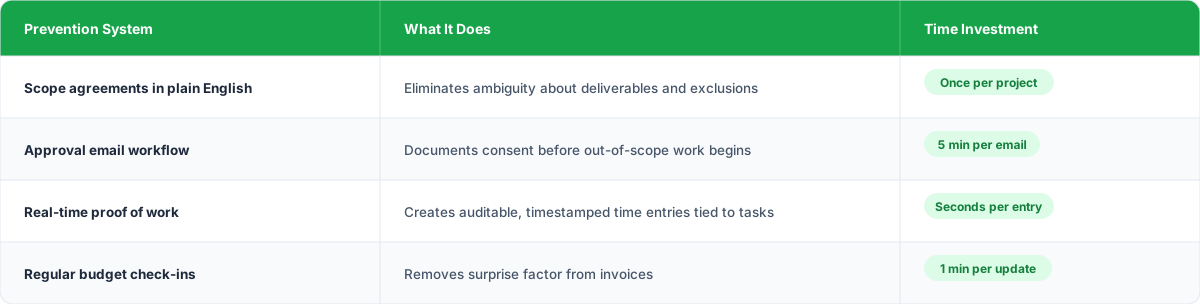
And here's the part that makes all of this sustainable: once you build the system, it takes less time than dealing with a single dispute. The approval email takes five minutes. The budget check-in takes one minute. Logging time in real time takes seconds per entry. A billing dispute takes hours. Sometimes days. Sometimes it costs you the client entirely.
Fierce Inc. found that 86% of executives cite ineffective communication as the top reason for workplace failures. Agency billing disputes are exactly that failure, just with a dollar sign attached. Fix the communication, and you fix the billing.
You don't need a law degree or a 50-page contract. You need a scope document written in plain English, an approval email habit, time tracking with an audit trail, and regular budget check-ins. Four systems. That's it.
The agencies that build these systems keep their clients and their money. The ones that don't keep posting on social media, hoping someone has advice for getting paid for work they've already done.
Build the system before you need it. Because by the time you need it, it's already too late.
Frequently asked questions about agency billing disputes
What causes billing disputes at agencies?
Billing disputes are caused by vague scope documents, missing change request approvals, retroactive time tracking, no budget check-ins, and silent scope creep. The common thread is always a documentation gap: the client can't verify the work happened because the agency didn't create a paper trail as they went.
How can agencies prevent billing disputes?
The most effective prevention system has four components: scope agreements written in plain English with explicit exclusions, approval emails sent before doing any out-of-scope work, real-time time tracking with detailed entries, and regular budget check-ins so the invoice is never a surprise to the client.
How much do billing disputes cost agencies?
Beyond the disputed invoice itself, billing disputes cost agencies in time spent reconstructing timelines, damaged relationships (1 in 3 customers leave after one bad experience, per SuperOffice), emotional stress, and opportunity cost. With average agency net margins around 10% (Parakeeto, 2024), a single dispute can erase an entire month's profit.
What should an agency scope of work include?
An effective agency scope of work includes specific deliverables, explicit exclusions (what's not included), a clear definition of what counts as a "revision," and a documented change request process requiring written approval before out-of-scope work begins. Write it in plain English, not legalese.
How do I handle a client who disputes an invoice?
Prevention is always better than resolution. But if a dispute happens, you need timestamped time entries, documented client approvals, and a communication history showing you flagged overages before they occurred. Without this documentation trail, you're relying on trust alone, and trust doesn't win billing arguments.
What is an approval email workflow for agencies?
An approval email is a short message sent to the client the moment a project approaches its hour estimate. It states hours used, what caused the overage, estimated additional hours needed, and asks for explicit approval before continuing. This creates documentation and eliminates surprise invoices.