


The Spreadsheet Tax: What Agency Chaos Actually Costs You
I lost a $10,000 invoice because I couldn't prove my hours.
Not because I didn't do the work. I did the work. Sixty-three hours of it across a five-week sprint for a client who wanted a complete web app rebuild. I tracked every hour in a Google Sheet. Columns for date, task description, time spent. It was meticulous. It was beautiful. And it was completely useless the moment the client said, "We don't believe these numbers."
No timestamps. No audit trail. No tied-in communication history showing when they requested changes at 11pm on a Friday (they did). Just a spreadsheet that I maintained by hand, from memory, usually two or three days after the work actually happened.
The client didn't pay the overage. I ate it. And honestly, I couldn't even be mad at them. If someone handed me a self-reported Excel file as "proof" of 63 hours of work, I'd be skeptical too.
That was the moment I started calculating the true agency project management cost. Not just the disputed invoice, but everything. The time spent updating spreadsheets instead of doing billable work. The mental energy burned jumping between six different tools. The slow erosion of client trust every time something slipped through the cracks.
What I found was a number so big I didn't believe it at first.
I call it the Spreadsheet Tax. And you're paying it right now, whether you realize it or not.
The hours you're not billing
Let's start with the most obvious cost, because it's also the one agency owners are most in denial about: time you work but never invoice.
Here's how the math breaks down. The average knowledge worker burns 28% of their week just managing email. Another 20% goes to searching for information or hunting down someone who can answer a question. That's 48% of your week gone before you've done a single billable thing.
Let me make that real. If you're a solo operator billing at $125/hour with 2,080 working hours per year:
- Email and message management eats 28% of your week. That's 11.2 hours, or 537 hours a year.
- Another 20% goes to searching for information. 8 hours a week. 384 hours a year.
- Total: 921 hours of non-billable admin time per year.
- At $125/hour, that's $115,200 in opportunity cost. Gone.
Even if you cut that in half and say only 50% of that time is truly avoidable, you're still looking at $57,600 per year evaporating into admin work. That's a salary. A full salary, vanishing into admin.
And here's the thing: those numbers are from general knowledge workers. Agency owners juggling five, eight, twelve clients across email, Slack, text messages, and the occasional phone call? It's worse. Much worse.
When I was running my agency at four clients, here's what my daily "spreadsheet tax" looked like:
- 20 minutes updating task statuses across four tabs every morning
- 15 minutes copying client requests from email and Slack into the sheet
- 30 minutes on Friday reconstructing time entries I forgot to log during the week
- 10 minutes fixing a formula that broke because I inserted a row wrong
- 45 minutes at month's end pulling together a client "report" that was really just a filtered view of my own messy data
That's roughly two hours a day. Ten hours a week. At $125/hour, I was paying a $1,250 weekly tax to maintain a system that was supposed to be saving me money.
The average agency net profit sits around 10%. The healthy target is 25 to 30%. That gap between "surviving" and "thriving" is $150,000 per year for a million-dollar agency. And agencies lose 10 to 20% of gross margin annually to non-billable time that should've been billed but wasn't.
Your spreadsheet isn't free. It's one of the most expensive tools in your business. You just can't see the invoice.
Context switching is frying your brain
The billable hours problem is bad enough. But there's a cost that's harder to measure and honestly, more destructive. What all that context switching does to your brain.
There's a well-known breakdown of what multitasking actually costs you. The numbers are brutal:
- 1 project: 100% of your productive time available
- 2 projects: 40% each (20% lost to switching)
- 3 projects: 20% each (40% lost to switching)
- 5 projects: you're spending more time switching than working
Think about your last Tuesday. You're heads-down on a design comp for Client A. Email pops up from Client B about billing. You open your spreadsheet to check their hours. While you're in there, you notice Client C's tasks haven't been updated since last week. You start fixing it. Phone buzzes. Slack from Client D about a deadline.
Sound familiar?
The average person spends only 3 minutes on a task before switching to something else. Workers toggle between apps roughly 1,200 times per day, losing about 4 hours per week just to refocusing.
Four hours per week of literally zero output while your brain tries to remember where it was.
Even software developers, who are arguably more focused than the average person, only spend 41% of their day on actual development work. The rest is meetings, email, Slack, and the mental wind-down/wind-up cycle of switching between contexts.
When I was managing eight clients across separate spreadsheets, separate email threads, and separate Slack channels, my brain was never fully on any one thing. When you switch tasks, part of your attention stays stuck on the previous one. You're never 100% here because part of you is still back there.
At eight concurrent client contexts, I was losing 40% or more of my productive capacity to switching alone. On an 8-hour day, that's 3.2 hours of productivity gone. At $125/hour, that's $400 per day. Roughly $96,000 per year in productivity I'll never get back.
And that's just the time. The cognitive drain is what really gets you. You know your spreadsheet is probably wrong somewhere. You just don't know where. And at 9pm, you're lying in bed trying to remember if you logged that call with Client B or not.
The most frustrating part about running an agency is the amount of shit you have to do around the actual work, just to get the requirement out the door. The amount of mental energy expended on trivial work around the work is insane.
This is how you lose clients
The spreadsheet tax stops being about money at some point and starts being about relationships. Agencies don't lose clients over one big failure. They lose them over dozens of small ones.
A request that fell through the cracks because it was buried in an email thread you forgot to copy into your [request tracker](/blog/request-ticket-management-for-agencies). A deadline you missed because your spreadsheet showed the wrong date after a formula update. An invoice the client disputed because your time log didn't match their memory of the project scope.
Each one of these moments is tiny. Forgivable, even. But they compound.
I had a client once, great relationship for about six months. They sent a revision request on a Tuesday via email. I meant to add it to my spreadsheet that evening. Got pulled into a call. Forgot. By Thursday they asked where their revision was. I scrambled. Delivered it Friday morning. Apologized.
They said it was fine.
But it wasn't fine. Because two weeks later, when I sent the monthly invoice, they questioned three line items. Not because the hours were wrong, but because the trust had cracked. Once a client starts scrutinizing your invoices, the relationship is already on life support. And billing disputes like this are almost always preventable with proper systems.
Here's the reality: 88% of spreadsheets contain errors. Not 8%. Eighty-eight percent. And those are spreadsheets in general, from banks to universities to Fortune 500 companies with entire teams dedicated to data integrity.
If organizations with massive resources can't keep their spreadsheets error-free, what chance does a solo agency owner updating theirs between client calls have?
You've probably seen the horror stories. Banks losing billions from a single wrong formula. Government agencies losing thousands of records because they hit an Excel row limit. A $24 million charge from a copy-paste error. Those feel extreme, right?
But scale it down to your world. A missed hour here, a wrong rate there. When your net profit is 10%, a billing error on a $5,000 invoice doesn't just cost you $500. It might wipe your profit on that client for the entire month.
Bad data costs the U.S. economy an estimated $3 trillion per year. Your slice of that pie may be small. But it's real, it's consistent, and it's compounding.
It all compounds (that's the scary part)
None of these costs exist on their own. They feed each other in a cycle that's hard to see and harder to break.
You're context-switching all day, so your time tracking gets sloppy. Sloppy time tracking leads to inaccurate invoices.
Inaccurate invoices lead to billing disputes. Billing disputes erode client trust. Eroded trust means you spend more time on status updates and justification emails. Those emails add to your admin overhead. More admin overhead means more context switching. And the cycle tightens.
Let me stack the numbers for a solo agency owner at $125/hour:
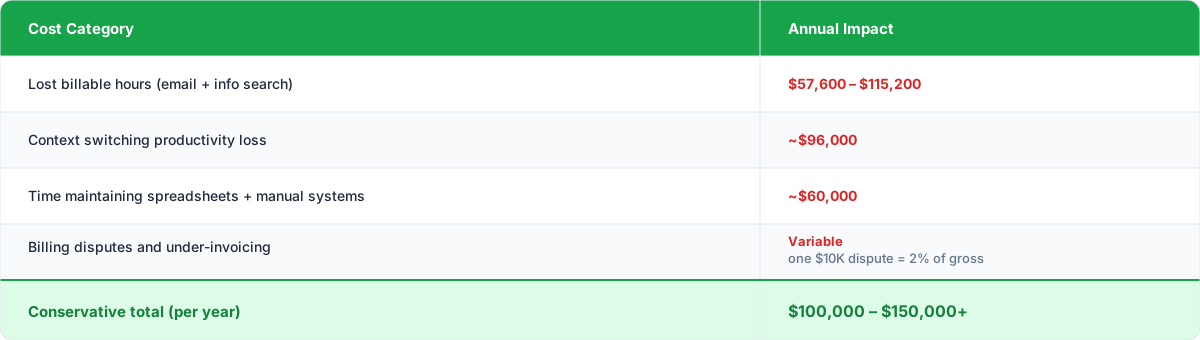
Even if you aggressively discount these numbers, even if you say "that's not me, I'm more disciplined than that," the floor is still five figures. A direct hit to agency profitability that most operators never see because they're too busy paying the tax to calculate it.
And then there's the cost you can't quantify at all: clients you never landed because you were too buried in admin to follow up. Projects you scoped wrong because you were referencing outdated data. Referrals that went to another agency because your current client had one too many "sorry about that" moments.
58% of freelancers have more than 5 clients at any given time. 25% of freelancer time goes to prospecting alone. When your operational chaos is eating into the 75% that's left for actual work and admin, something has to give. Usually, it's quality. Sometimes, it's your sanity.
Calculate your own Spreadsheet Tax
Enough theory. Let's get your actual number.
Grab a calculator. Not a spreadsheet. The irony would be too much.
Step 1: Your Billable Rate and Capacity
- Your effective hourly rate:** $______/hour
- Working weeks per year: 48 (assuming 4 weeks off)
- Hours per week: 40
- Total annual capacity: 1,920 hours
Step 2: Time Spent on Admin and Tool Maintenance
Be honest with yourself here. Track it for one week if you need to.
- Hours per week managing email for client work: ______
- Hours per week updating spreadsheets/trackers:______
- Hours per week searching for client info across tools: ______
- Hours per week in "status update" meetings that exist because info isn't centralized: ______
- Hours per week reconstructing time entries after the fact: ______
- Total admin hours per week: ______
Step 3: Calculate Your Annual Tax
Total admin hours × 48 weeks × your hourly rate = Your Spreadsheet Tax
Example Calculations
The Solo Designer at $100/hour:
- 8 hours/week on admin across 4 clients
- 8 × 48 × $100 = **$38,400/year
The Freelance Developer at $150/hour:
- 12 hours/week on admin across 6 clients
- 12 × 48 × $150 = **$86,400/year
The Small Agency Owner at $125/hour:
- 15 hours/week on admin across 8 clients
- 15 × 48 × $125 = **$90,000/year**
Now here's what should keep you up at night: what would you do with that money if you got even half of it back?
At $90,000 per year in lost capacity, recovering just 50% of that time means $45,000 in additional billings. Or 360 hours you could spend on higher-value work. Or, honestly, 360 hours you could spend not working. Taking a Friday off. Not checking Slack at 10pm. Whatever matters to you.
The Tool Sprawl Multiplier
There's one more input most people forget: the tools themselves. The average company runs over 300 SaaS applications, and about half those licenses sit unused. That means you're paying for software that's just collecting dust.
For agencies, the [tool sprawl](/blog/tool-stack-optimization-for-agencies) is particularly painful. You've got a project management tool, a time tracker, an invoicing app, a CRM, email, Slack, a file storage service. Each one costs $10 to $50 per month. Each one holds client data the others can't see. And every extra tab is another place where something can fall through the cracks.
When even mid-size companies with dedicated ops teams can't keep track of what they're paying for, what chance does a solo operator have?
Your Spreadsheet Tax isn't just about spreadsheets. It's everything you pay, in time and money, because your tools don't talk to each other.
You already know it's broken
You feel it every morning when you open that spreadsheet and your stomach drops a little.
I've experienced every single one of these. If they sound familiar, you're not alone:
- You're logging time from memory.If you're sitting down on Friday trying to reconstruct what you did on Tuesday, your time records are fiction. Professional, well-intentioned fiction, but fiction. You're almost certainly under-billing, which means you're doing free work and calling it "close enough."
- You've said "sorry, that fell through the cracks" to a client recently. Once is a mistake. Twice is a pattern. Three times and the client is already shopping for your replacement. They won't tell you. They'll just go quiet.
- You dread opening your own tracking system. That feeling in your gut when you know you need to update your spreadsheet but you'd rather do literally anything else? That's your subconscious telling you the system is broken. If the tool that's supposed to reduce stress is creating it, that tells you everything you need to know.
- A client has questioned an invoice. This is the big one. The moment a client doubts your hours, your spreadsheet becomes a liability, not an asset. Their next question will be, "Can you show me exactly what you did on each of those days?" And if all you have is a self-reported spreadsheet, you've already lost that argument.
- You have multiple versions of the same document. Client A's project plan lives in a Google Sheet. The backup is on your desktop. You emailed a version to the client last month, and you've made changes since. Now nobody knows which version is current. Including you.
- You're working nights and weekends on admin, not client work. If your evenings are spent updating trackers, sending status emails, and organizing files instead of actually delivering, your operational overhead has consumed your life. If you're doing all that, you're employed by your own chaos — not running a business.
- Your "system" lives only in your head. You know where everything is. You remember which client prefers email over Slack. You keep mental track of who's approaching their retainer cap. Great. Until you get sick, take a vacation, or just have an off day. There's no backup for your brain.
If three or more of these ring true, your Spreadsheet Tax is already eating your agency profitability, your client relationships, and probably your sleep.
What actually works (a systems hierarchy)
I tried everything before figuring out what actually works. Spreadsheets, Asana, Monday, Trello. I looked at Freshdesk and Help Scout. Everything was either built for enterprise teams or too focused on IT workflows. Paying for a platform that wasn't meant for agency project management felt like paying for a car you could only drive on certain days of the week.
Here's what I learned: the tool matters less than the system, but eventually the system demands the right tool.
Level 1: Fix your habits first (Free)
Before you spend a dollar, get your fundamentals right.
Time block your admin work. Don't check email all day. Don't update your tracker every time a Slack message comes in. Set specific times for admin. I moved email and messages to after lunch, and the cognitive relief was immediate.
Log time as you work, not after. The gap between real-time logging and end-of-week reconstruction is the gap between accurate invoices and billing disputes. This single habit change is worth more than any software.
Close open loops daily. Loose ends and unattended issues drain you. Before you shut down for the day, capture everything that's pending somewhere. One place, not four.
Level 2: Consolidate your tools (Low cost)
You don't need 15 SaaS tools. You probably don't even need 10. But you do need to stop using six different ones to do what one should handle.
Here's the bare minimum a healthy agency needs:
You need somewhere to capture client requests that isn't your email inbox. You need time tracking that lives where the work happens, not in a separate app. You need a searchable communication history with timestamps. And you need billing and retainer data that runs on actual numbers, not manual formulas you're scared to touch.
That's it. Four things. Everything else is optional.
Level 3: Use a purpose-built system
Here's the honest truth. I built Sagely because the tool I needed didn't exist. I hit every single breaking point on the list above and realized that duct-taping five tools together was the problem, not any one of those tools individually.
Sagely is a multi-client helpdesk built specifically for agencies. Everything lives in one workspace: tickets, time tracking, retainer management, files, client communication. Clients reach you however they want (Slack, email, a self-serve portal) and it all lands in the same place.
Time gets tracked alongside the work, not in a separate app you forget to open. And when a client questions an invoice, you pull up timestamps and communication logs instead of a self-reported spreadsheet.
Starting at $14.99/month for solo operators, it costs less per month than a single hour of the billable time you're currently losing to admin chaos.
Look, I know how this reads. But the math is the math. If your Spreadsheet Tax is $40,000 per year (conservative for most agency owners), and the solution costs $180 to $948 per year depending on your plan, the ROI isn't even a conversation. It's arithmetic.
Calculate your ROI with a 14-day free trial →
The invoice I'll never get back
I think about that $10,000 invoice sometimes. Not with anger, but with clarity.
What I learned from losing that money wasn't something a blog post or business book could have taught me. The real agency chaos costs of doing things the "scrappy" way aren't the disasters. The one big dispute, the one lost client. Those are dramatic. What actually kills you is the daily, invisible, compounding tax you pay in lost hours, lost focus, and lost trust.
Every hour I spent maintaining spreadsheets was an hour I didn't bill. Toggling between apps cost me focus I never got back. And every dropped request chipped away at trust that took months to build.
I get it, sometimes the spreadsheet feels like enough. Sometimes "good enough" is genuinely good enough. If you've got one or two clients with stable scopes and you're updating your tracker in under 15 minutes a day, keep doing what you're doing. Seriously.
But if you're reading this and doing the math in your head, if the numbers are making you uncomfortable, listen to that. Your gut is telling you what your spreadsheet can't: the tax is too high.
There will always be a reason to put off fixing this. Payroll is due. A big deadline is coming. You'll do it next quarter. I told myself those things for two years. And every month I delayed, the tax kept compounding.
The spreadsheet doesn't send you a bill. But make no mistake. You're paying.
For a deeper dive on when to keep your spreadsheet and when to replace it, check out the complete guide to spreadsheet alternatives for agencies.
Ready to stop paying the Spreadsheet Tax? See how Sagely replaces scattered tools with one purpose-built agency platform →
Frequently Asked Questions
How much does agency chaos actually cost?
I calculated mine at over $100K/year when I added it all up. Most solo operators land somewhere between $40K and $150K annually once you factor in lost billable hours, context switching, system maintenance, billing disputes, and the work you just forgot to invoice. Your number depends on your rate and how many clients you're juggling, but it's almost always higher than you think.
Why are spreadsheets bad for running an agency?
They're fine for two clients with simple scopes. Beyond that, you're fighting the tool instead of using it. 88% of spreadsheets have errors, they can't give clients an audit trail when they question your hours, and every time you insert a row your formulas break. I spent more time maintaining mine than it would've cost to just pay for a real system.
What's a healthy admin overhead for an agency?
Industry average net margin is about 10%. Agencies with tight operations hit 25 to 30%. If you're spending more than a quarter of your week on admin, tracking, and tool juggling, that's where your margin is going. I didn't believe it until I actually tracked it for a week.
When should I ditch spreadsheets?
Honestly? If you have more than two or three active clients and requests come in through multiple channels, you're probably already past the point where spreadsheets make sense. The dead giveaway is logging time from memory days after the work happened. If that's you, your time records are fiction and your invoices are vulnerable.
Why do billing disputes happen so often at agencies?
Because most of us track time manually, usually days late, in a tool that has no connection to the actual work or communication. So when a client says "I don't think that took 8 hours," all you've got is a spreadsheet entry that says it did. No timestamps, no request trail, no proof. The fix is tracking time where the work happens, not in a separate app.
Sources
Data points referenced in this article:
- Ray Panko, spreadsheet error rates (88% of spreadsheets contain errors). MarketWatch, April 2013
- McKinsey Global Institute, "The Social Economy: Unlocking Value and Productivity Through Social Technologies." July 2012 (28% of workweek on email, 20% searching for information)
- Harvard Business Review, "How Much Time and Energy Do We Waste Toggling Between Applications?" August 2022
- Gerald Weinberg, "Quality Software Management: Systems Thinking" (context switching productivity model)
- Parakeeto, "How to Calculate Project and Client Profitability for Agencies." 2025 (agency profit benchmarks, 10-20% margin lost to non-billable time)
- Thomas C. Redman, "Bad Data Costs the U.S. $3 Trillion Per Year." Harvard Business Review, September 2016
- Zylo, 2026 SaaS Management Index (305 SaaS apps per company, 54% license utilization)
- Millo, "Freelance Statistics." January 2024 (58% have 5+ clients, 25% time on prospecting)
- RescueTime (developers spend 41% of day on actual development work)