


Agency pricing psychology: how clients buy, decide, and stay
Here's a truth that took me years and a lot of lost revenue to figure out: the best agency operators aren't the best at the work. They're the best at understanding people.
I used to believe that if I just delivered better campaigns, tighter code, sharper designs, the clients would come. And stay. And refer their friends. I'd show up to pitches loaded with case studies and technical breakdowns, ready to prove I was the smartest person in the room. And I watched client after client go with someone else. Someone who, frankly, I knew wasn't as good and It drove me insane. Until I realized I was playing the wrong game entirely.
The psychology behind client buying behavior, how they choose, stay, and leave, is the single most important thing agency operators don't study. Understanding it is the difference between knowing how to sell agency services and wondering why the phone stopped ringing.
We obsess over deliverables and ignore the fact that our entire business runs on human decision-making. Messy, irrational, gut-driven human decision-making. And once you understand that, everything about how you sell, price, and retain clients changes.
Agency business psychology is the study of how clients evaluate, choose, and commit to agency partnerships. It covers buying behavior, risk perception, pricing psychology, credibility signals, and the sales tactics that actually influence decisions. Understanding it is the difference between agencies that consistently close and agencies that wonder why qualified leads go silent.
What this article covers:
- How clients actually make buying decisions (and why your expertise isn't what closes the deal)
- Why 61% of lost deals die to indecision, not competitors, and how to de-risk your sales process
- Agency pricing psychology: why price objections are really risk objections in disguise
- The credibility signals that actually convert prospects into clients
- Sales psychology tactics that separate agencies that close from agencies that hope
How clients actually make buying decisions
Let's start with the uncomfortable part. Most buyers can't evaluate your technical ability. They literally don't have the expertise to judge whether your strategy is better than the next agency's. That's the whole reason they're hiring someone in the first place.
"Quality" is ssubjective as hell.
So every minute you spend flexing credentials and walking through your elegant solution, you're talking yourself out of the sale. Their eyes glaze over. They check out. They start feeling a pit in their stomach that maybe they shouldn't have scheduled this call.
Here's the thing: by the time a client reaches out to you or agrees to a call, you've already passed the smell test. HubSpot's 2025 Sales Trends Report puts it plainly: 96% of prospects research companies before they ever engage with a sales representative.
And 71% prefer to do that research independently rather than talk to a rep. Foleon's data tells the same story: close to 70% of the B2B buyer's journey is completed before a prospect ever reaches out.
They've already been to your website. They've read your testimonials (or noticed you don't have any). They've probably checked your LinkedIn, your social presence, maybe even asked around. DemandBase found that 48% of B2B buyers rely on vendor websites for research and ROI analysis.
Weidert Group puts it even starker: 77% of B2B buyers say they're spending more time on research than in previous years.
Your prospects are doing their homework long before they ever reach out. The real question is whether what they find makes you look trustworthy or makes them nervous.
And here's where it gets complicated. HubSpot puts the average at 5 decision-makers per sale. Gong Labs takes it further: 81% of revenue leaders say their deals are more complex than ever.
Large strategic deals include an average of 17 contacts. This isn't one person making a gut call anymore. It's a buying committee, often spread across locations, teams, and roles. Magento's research confirms it: 75% of B2B buyers agree their purchases were a collective effort across a wide variety of people.
So what do all those people actually care about? DemandBase broke down the top three reasons B2B buyers chose a vendor over others: the vendor's knowledge of the solution and business environment (69%), the vendor's knowledge of the buyer's company and needs (65%), and the vendor's ability to provide content that made it easier to build a business case (62%).
Read that again. Not one of those is about your portfolio. Not one is about your pricing. They chose the vendor who understood their world and made their internal decision easier.

The elimination game
When buyers start shopping for help, they become detectives with a rough budget and a vague idea of what they need. Some vendors make it easy. They show up unprepared, don't listen, talk too much. They eliminate themselves before the meeting even ends.
Other vendors are trickier, they nail the talking points, their websites look slick, and they seem legit.
So how do buyers actually decide? They start scanning for flaws. Little inconsistencies that make them think, "hmm, maybe this person isn't what they seem." Clients see every little red flag as risk, and those start to add up.
Here's what they're scanning for:
- Your message, brand, and actions don't line up
- You barely exist online or in the market
- You're missing credibility signals like real testimonials and reviews
- You come across as unsure of yourself
- Your proposal is generic, not tailored to their specific situation
On their own, these things might feel small. But to the buyer, they stack up. Each one adds to the pile of risk. Each one gives them another excuse to cross you off and move on.
And when you don't make their short list, nobody tells you. They don't call or email. You just never hear from them again. That radio silence is the market cutting you out for someone else.
We go much deeper into the full two-phase buying journey, confirmation bias, and what the 6sense data reveals about pre-contact favorites in our full guide on how clients actually make decisions.
Why most agency deals die to indecision, not competitors
Most agency deals don't die to competitors with better work or lower prices. They die to fear. Buyer indecision kills more deals than pricing, competition, or timing combined. And once you understand that, it changes how you approach every sales conversation.
I lost a $35,000 project once that I absolutely should have won. The client loved our initial call. They told me directly that our approach was the best they'd seen. Our proposal was tailored, detailed, and priced fairly.
Then they went with a bigger agency that charged 40% more. When I eventually found out why (through a mutual contact, months later), the answer gutted me: "We just felt safer going with the bigger name."
That's it. Not better. Not cheaper. Safer.
Ebsta's B2B Sales Benchmarks puts a number on it: sales reps attribute 61% of lost deals to buyer indecision. Not to a competitor win. Not to pricing. Indecision, the buyer simply couldn't pull the trigger. They chose to do nothing because the risk of making the wrong choice felt worse than the cost of staying put.
This is the thing most agency operators completely miss. Most of the time, the real competition isn't other agencies — it's the fear of getting burned again.
Your prospects have hired the wrong consultants before. They've been promised the world and handed garbage. They've sat through pitches from smooth talkers who disappeared after the contract was signed. And 77% of B2B buyers (per Magento) say their last purchase was complex or difficult. That experience isn't neutral — it's painful. And painful experiences create gun-shy buyers.
"Consultants take your watch and then charge you for the time."
"Consultants rent you your own ideas by the hour."
That cynicism exists because it's been earned. Repeatedly. By other agencies. And now you're the one paying for it.
HubSpot found that 28% of sales pros say lengthy sales processes are the primary reason prospects back out. The longer someone has to sit with a decision, the more opportunities they find to talk themselves out of it.
DemandGen's research confirms the trend: 68% of B2B buyers say their purchase cycles have gotten longer. That's more time for doubt to creep in. More time for a committee member to say, "maybe we should just handle this internally."
How to de-risk the decision
If risk is the real enemy, then every touchpoint in your sales process should be designed to lower it. Not to impress. Not to dazzle. To make saying "yes" feel safe.
- Start small. Offer a phased engagement instead of a massive upfront commitment. A paid discovery sprint. A pilot project. Let them experience working with you before they bet the farm.
- Show, don't tell. Case studies with specific outcomes. Client testimonials that sound like real humans, not marketing copy. Process documentation that shows you've done this before and know exactly how it works.
- Make the internal sell easy. Remember, 62% of buyers chose a vendor partly because that vendor provided content that made it easier to build a business case internally. Give your champion the ammunition they need to convince the rest of the committee.
- Be responsive. DemandGen's 2024 B2B Buyer's Survey found that 26% of buyers say the current environment requires more hands-on attention from solution providers. When a prospect emails you, respond quickly. When they ask a question, answer it thoroughly. Every delay adds risk in their mind.
For the full JOLT framework, the Transparency Paradox, and a complete playbook for structural de-risking, read our deep dive on buyer risk perception.
Agency pricing psychology (what actually matters)
Agency pricing psychology comes down to how price perception, risk aversion, and value framing influence a client's decision to buy. It has nothing to do with setting the lowest price. The goal is making value so clear that the price feels like an investment, not a cost.
Let's get this out of the way: price is almost never the real objection.
When a client says "it's too expensive," what they're actually saying is one of three things: "I don't understand the value," "I can't justify this internally," or "I'm scared this won't work and I'll have wasted the money." All three are risk problems, not price problems.
But pricing does matter in the decision process, just not the way most agencies think. Demand Gen's research shows pricing ranks as the number two most important factor (72%) when B2B buyers evaluate solution providers, just one point behind features and functionality (73%). Reviews came in at number three (59%).
Here's where it gets interesting.
Showpad's data reveals that disagreements over price (37.96%) is the single biggest reason the B2B buying process takes longer. Disagreements over ROI (22.71%) is another major delay factor. And difficulty understanding information (32.62%) slows things down further.
Here's what that tells you: the price conversation isn't really about price. It's about clarity. When buyers argue about cost, they're really saying they can't see the ROI clearly enough to justify the spend. DemandGen found that 70% of B2B companies now conduct more detailed ROI analyses before making a final purchasing decision.
So the game isn't to lower your price. It's to make the value so obvious that the price feels like a bargain.
Value-based positioning vs. hourly billing
I made the switch from hourly billing to value-based pricing about three years into running my agency, after a client questioned a $4,200 invoice line by line for 45 minutes on a call. Every hour I'd logged felt like a courtroom exhibit. That's when I realized: as long as I was selling hours, I'd always be defending my time instead of proving my value.
The shift changed how I ran my business. My revenue went up, yes. But more than that, it changed how clients perceived me.
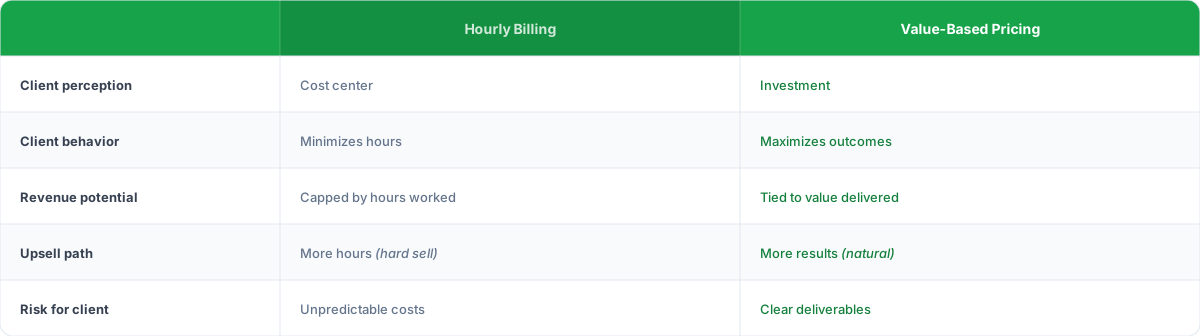
When you bill by the hour, you're a cost center. The client watches the clock. Every email, every revision, every five-minute Slack call becomes a line item they're tracking in their head. They start optimizing for fewer hours instead of better outcomes. And you start feeling pressure to rush through work so you don't "cost too much."
When you price based on outcomes, you're an investment. The conversation shifts from "how many hours will this take?" to "what will this achieve?" That's a different kind of relationship entirely.
Here's a framework that's worked for me:
- Anchor high, then offer options. When you present one price, the client's only decision is yes or no. When you present three tiers (and the top one is ambitious), the middle option suddenly looks reasonable. The anchoring effect is real. Use it.
- Frame everything around their outcomes, not your activities. Instead of "40 hours of design work," try "a conversion-optimized landing page system projected to increase qualified leads by 30%." Same work. Completely different perceived value.
- Break the scope into phases with clear deliverables. This reduces perceived risk (there's that word again) because the client can evaluate results before committing to the next phase.
HubSpot's numbers tell the story: 72% of company revenue comes from existing customers, not new ones. And 91% of salespeople engage in upselling, contributing an average of 21% to company revenue. When you build pricing around outcomes and deliver results, expanding the relationship becomes natural. The upsell isn't more hours — it's more results.
If you're still tracking every hour manually and fielding billing disputes because clients don't trust your time logs, that's a systems problem worth solving. We covered this extensively in our piece on agency time tracking and billing dispute prevention. And for the complete breakdown of anchoring, tiered pricing, proposal psychology, and the expansion economy, see our full guide on agency pricing strategy.
Building credibility signals that actually convert
Here's the hard part about selling agency services: your product is invisible.
You can't demo a campaign that doesn't exist yet. You can't let someone test-drive a strategy. Unlike software (where there's a free trial) or a physical product (where you can hold it in your hands), agency services are a promise.
A really expensive promise.
Which means credibility signals aren't nice-to-haves. They ARE your product during the sales process. They're the only way prospects can de-risk hiring you before they've experienced your work.
The numbers prove it.
Reviews are non-negotiable
BrightLocal's 2026 Consumer Review Survey spells it out: 97% of consumers read reviews for businesses. Not "some" consumers. Virtually all of them. And 85% say positive reviews make them more likely to use a business.
But here's where it gets specific and actionable:
- 47% of consumers won't use a business with fewer than 20 reviews. If you have three testimonials on your website, that's not enough. Not even close.
- 74% of consumers only care about reviews written in the last 3 months. That glowing testimonial from 2022? It might as well not exist. Recency matters enormously.
- 68% will only use a business with 4+ stars (up from 55% the prior year). The bar keeps rising.
- The average consumer uses 6 different review sites when choosing businesses. They're not just checking your website. They're checking Google, LinkedIn, Clutch, and anywhere else your name shows up.
When I checked my own agency's review count a couple years ago, I had exactly four. Four. I might as well have had zero. I'd been so focused on doing good work that I never asked anyone to talk about it publicly.
Meanwhile, agencies with mediocre work but 30 reviews were getting calls I never even knew existed.
And here's the one that should change your behavior immediately: BrightLocal found that 80% of consumers say they're likely to use a business that responds to all of its reviews. Meanwhile, 42% are unlikely to use a business that never replies. And 50% are put off by generic or templated responses.
Responding to reviews (authentically, not with copy-paste templates) is one of the highest-leverage activities you can do for your agency's credibility. It signals that you care enough to engage. That you're a real human running a real business.
What late-stage buyers actually want to see
Not all content is created equal. Demand Gen's research shows what buyers want depends on where they are in the decision process:
- Early-stage buyers prefer listicles (81%), infographics (72%), and blog posts (66%). They're learning. They want education and context.
- Mid-stage buyers want assessments (58%), webinars (50%), and case studies (40%). They're evaluating. They want to see how you think.
- Late-stage buyers (the ones closest to saying yes) prefer case studies (39%) and user reviews (38%). They want proof. They want evidence that you've done this before and it worked.
This matters more than most agencies realize. Your blog posts and social content attract prospects early. But the content that actually closes deals is case studies and reviews. If you're not actively building both, you're losing at the finish line.
DemandBase found that 97% of B2B buyers expect your website to have content relevant to their company. And 96% want to see demonstrated industry expertise. Generic "we do great work" pages don't cut it.
How AI is changing the way clients evaluate agencies
Here's something most agencies aren't paying attention to yet. BrightLocal's data shows that 45% of consumers now use ChatGPT and other generative AI tools for local business recommendations. That's up from 6% just the prior year.
And 42% of consumers trust AI recommendations as much as traditional reviews.
What does that mean for you? It means your credibility signals need to exist in places AI can find and reference.
Your reviews, your case studies, your content, all the signals you've built need to be publicly accessible and well-structured. Because increasingly, the first "person" evaluating your agency isn't a person at all.
BrightLocal takes it further: 82% of consumers read AI-generated review summaries, and 23% are willing to rely solely on those summaries to make a decision. Your reviews are being aggregated, summarized, and served up by AI before a prospect ever visits your website.
For the complete credibility playbook, including the ask gap, case study frameworks, content-by-buyer-stage strategy, and a 30-minute credibility audit, read our full guide on building credibility signals.
Agency sales psychology: why relationships beat pitch decks
Agency sales comes down to three things: building real relationships, following up consistently, and understanding how people actually make decisions. Not slick proposals. Not rehearsed pitches. The operators who learn these fundamentals outperform everyone else by a mile.
I'll be honest: I never thought of myself as a "salesperson." I was a strategist, a creative, a builder. Sales felt like the sleazy part of business that I tolerated because I had to.
That mindset cost me hundreds of thousands of dollars over the years.
Because selling agency services isn't sleazy. It's a skill.
Why relationship-building closes more agency deals
HubSpot's 2025 Sales Trends Report puts a number on what most of us already feel: 82% of sales professionals say building strong relationships is the most important and most enjoyable part of selling. This isn't soft advice. It's the data. The agencies winning the best clients are the ones investing in relationships, not the ones with the fanciest pitch decks.
HubSpot backs it up: 24% of high-performing sales teams emphasize a culture of trust, versus just 13% of underperforming teams. Trust isn't optional. It's the dividing line between teams that hit their numbers and teams that don't.
I learned this the hard way. Early in my agency career, I treated every prospect interaction as a performance. I'd rehearse my talking points. I'd have my case studies queued up. I'd try to control the conversation.
And then one day, a prospect told me something I'll never forget: "You're the first person who actually asked what we've tried before." That comment made me realize I'd been talking at people instead of listening to them. I'd been so focused on proving my expertise that I forgot to understand their problem.
The 70-30 rule, as HubSpot calls it: spend 70% of the conversation listening and 30% talking. Most agency operators flip that ratio entirely. They talk for 70% of the meeting and wonder why the prospect didn't convert.
The follow-up gap (where most agencies lose)
This one drives me crazy because it's so fixable.
Invesp's research lays it out: 80% of successful sales take five or more follow-up calls. Five or more. And yet, 48% of salespeople never make any follow-up attempts at all. Not one. And 44% give up after a single follow-up.
Read that again. Nearly half of all salespeople never follow up. And of those who do, almost all of them quit after one try.
Meanwhile, 60% of customers reject an offer four times before buying. Four times. That means the sale often happens on the fifth, sixth, seventh attempt. And you gave up after one.
I once closed a $20,000 retainer client who said no to my initial proposal. And no to my revised proposal. And no to my "let's start smaller" offer. On the fourth conversation (three months after the first one), they came back and said, "We're ready now. You were the only one who kept following up without being annoying."
That last part matters: "without being annoying." Following up doesn't mean badgering. It means staying present. Sharing something useful.
Checking in genuinely. Belkins found that the first follow-up email alone can increase reply rates by 49%. And cold email campaigns using 3 rounds typically generate the highest reply rates, averaging 9%.
Mailshake's 2025 State of Cold Email takes it further: senders who personalize every email individually achieve 2 to 3 times higher reply rates than those using basic templates.
Personalization isn't just using their first name. It's referencing their specific situation, their industry challenges, something from their website or social media. Something that proves you actually care about their business, not just their budget.
Multi-threading wins bigger deals
For agencies chasing larger engagements (say, $50K and up), there's another layer to this. Gong Labs found that 77% of deals are multi-threaded, meaning multiple people on the buying side are engaged. But here's the kicker: successful deals have twice as many buyer contacts as unsuccessful ones.
And the numbers get more dramatic at scale. Gong Labs' data shows multi-threading boosts win rates by 130% in deals over $50K. Selling teams for closed-won deals are 67% larger than those for lost deals. That means your chances of winning roughly double when you're talking to more than one person on the client side.
In practice, this means: don't just build a relationship with your main contact. Ask to meet the other stakeholders. Present to the team. Get multiple people invested in the decision. Because when your champion has to sell the idea internally and they're doing it alone, the odds are against you.
This connects directly to what we covered in building strong client relationships. The relationship isn't just with one person. It's with the organization. And the more touch points you have, the stickier the connection becomes, both before and after the deal closes.
How to ask for reviews and referrals (and why most agencies don't)
One more thing that surprised me in the data. BrightLocal found that 83% of consumers who were asked to write a review went on to leave one. And 28% of consumers will "always" write a review when asked, up from 16% the prior year. 94% are open to leaving a review if prompted at the right moment.
Most agency operators never ask for reviews. Never ask for referrals. Never ask for a testimonial. They deliver great work and hope the client will volunteer it. That's leaving credibility on the table.
Ask. Consistently. Right after a successful delivery or a milestone win. The worst they can say is "not right now."
For the complete sales framework, including the 6-stage agency sales process, multi-threading tactics, proposal psychology from the Proposify data, and follow-up cadences that actually work, see our full guide on agency sales psychology.
The psychology of agency business IS the business
Here's what all of this comes down to. Your clients aren't making rational decisions wrapped in spreadsheets and criteria matrices. They're making gut decisions wrapped in rational justification. They're scared of getting burned. They're overwhelmed by options. They're looking for reasons to trust you and, simultaneously, scanning for reasons not to.
Understanding this doesn't make you manipulative. It makes you better at your job. You start seeing what your clients are going through before they can even articulate it.
Look at what the numbers keep saying:
- Your buyers have done their homework long before they contact you (96% research first)
- Most deals don't die to competitors. They die to indecision (61%)
- Price objections are really risk objections in disguise
- Credibility signals (reviews, case studies, content) are your actual product during the sales process
- Persistence beats perfection (80% of sales take 5+ follow-ups, 48% of sellers never try once)
- Relationships beat pitch decks, every single time
Master the psychology and you master the business. Not because you're gaming anyone, but because you finally understand how people actually make decisions. And that understanding lets you show up differently. More confident, more in tune with what your clients actually need.
If your sales process still runs on scattered emails and proposals you forget to follow up on, tools like Sagely can help you build the kind of organized, transparent client experience that lowers risk from the first interaction. But the mindset shift has to come first.
Your clients are humans. Treat the sales process like a human relationship, not a transaction. Everything else follows from there.
Stop selling harder. Start paying attention.
Frequently asked questions about agency business psychology
What is agency business psychology?
Agency business psychology is the study of how clients evaluate, choose, and commit to agency partnerships. It covers buying behavior, risk perception, pricing psychology, credibility signals, and the sales approaches that influence decisions. Agencies that understand these dynamics close more deals and retain clients longer.
How do clients actually choose an agency?
Clients choose agencies primarily based on trust and perceived risk, not technical ability. Research shows 96% of prospects research agencies before engaging (HubSpot). The top factors are solution expertise (69%), knowledge of the buyer's needs (65%), and content that helps build an internal business case (62%), according to DemandBase.
Why do most agency deals fall through?
Most agency deals fall through because of buyer indecision, not competitor wins. Ebsta's B2B Sales Benchmarks found that 61% of lost deals are attributed to indecision. Buyers fear making the wrong choice more than they fear missing out, especially if they've been burned by bad agency hires before.
Should agencies use hourly billing or value-based pricing?
Value-based pricing typically outperforms hourly billing for agencies. Hourly billing positions you as a cost center where clients minimize hours. Value-based pricing frames you as an investment where clients focus on outcomes. The key is making value so clear that the price feels like a bargain, not a gamble.
How many reviews does an agency need to win clients?
According to BrightLocal's 2026 data, 47% of consumers won't use a business with fewer than 20 reviews. Additionally, 74% only care about reviews from the last 3 months. Agencies should actively request reviews after successful deliveries, since 83% of consumers asked to write a review actually follow through.
How many follow-ups does it take to close an agency deal?
Research from Invesp shows 80% of successful sales require five or more follow-up interactions. Yet 48% of salespeople never follow up at all, and 44% give up after just one attempt. Meanwhile, 60% of customers reject an offer four times before saying yes. Persistent, non-pushy follow-up is one of the highest-leverage sales tactics.
What credibility signals matter most for selling agency services?
The most important credibility signals are client reviews, detailed case studies, and industry-relevant content. Late-stage buyers prefer case studies (39%) and user reviews (38%) when making their final decision (Demand Gen). BrightLocal found that 97% of consumers read reviews, and 68% will only use a business rated 4+ stars.
How does pricing psychology affect agency sales?
Pricing psychology reveals that price objections are really risk objections in disguise. When clients say "it's too expensive," they usually mean they can't see the ROI clearly enough to justify the spend. DemandGen found that 70% of B2B companies now conduct detailed ROI analyses before purchasing, making value framing essential.