


Buyer Risk Perception: Why Clients Ghost You
I lost a deal last year that still stings. Not because it was big (it was, $40K annually). Not because the client went with someone better (they didn't). But because of what the prospect told our mutual contact three months later: "We just decided to handle it internally."
They didn't handle it internally. I checked. Their website hasn't changed. Their campaigns are running on the same broken playbook they described to me during our discovery call. They chose to do absolutely nothing. And they told themselves a story about "handling it internally" because that felt better than admitting the truth: they were too scared to pull the trigger.
That experience broke something in my brain. I'd spent years assuming that when I lost deals, it was because someone else won them. Better portfolio. Lower price. Bigger team. But the data tells a completely different story. And once you see it, you can't unsee it.
Buyer risk perception is the fear-driven calculation prospects run before hiring an agency. It explains why 61% of lost deals die to indecision, not competitors (Ebsta 2024). Understanding risk perception reveals that your real enemy isn't the agency down the street. It's the accumulated trauma from every bad vendor experience your prospect has ever had.
Why is "doing nothing" your biggest competitor?
This number changed how I think about sales. Ebsta's 2024 B2B Sales Benchmarks found that 61% of lost deals are attributed to buyer indecision. Not a competitor win. Not a pricing mismatch. The buyer simply couldn't commit. They stalled. They "needed more time." And eventually, they disappeared.
More than half the deals you're losing right now aren't going to another agency. They're going nowhere. The client stays stuck with their current (broken) setup because the risk of change feels worse than the cost of staying put.
And this isn't just a gut feeling on their part. These are experienced buyers making what feels to them like a rational decision. Magento's research shows 77% of B2B buyers say their last purchase was complex or difficult. That experience isn't neutral — it's traumatic.
They remember the last time they hired an agency that overpromised and underdelivered. They remember the consultant who disappeared after the contract was signed. They remember explaining to their boss why they spent $30,000 on a project that went sideways.
That baggage walks into every sales conversation you have. And it has nothing to do with you.
The cynicism runs deeper than individual bad experiences, too. Edelman's 2025 Trust Barometer found that 61% of people globally have a moderate or high sense of grievance, believing that businesses serve narrow interests rather than helping them.
Their 2026 data is worse: 70% of the global population has what they call an "insular mindset." They won't trust anyone who approaches them differently from what they're used to. Your prospects aren't just cautious. They're operating in an environment where distrust is the default.
So when your prospect goes quiet after a great discovery call, it probably isn't because they found someone cheaper. It's because the weight of all that accumulated distrust made "doing nothing" feel safer than betting on you.
Why do buyers freeze when choosing an agency?
Why do clients freeze? Behavioral psychology has the answer. This isn't academic theory for fun. It's what actually drives every buying decision your prospects make.
Loss aversion: pain hits twice as hard
Daniel Kahneman's research on prospect theory (the work that won him a Nobel Prize) showed something agency owners need to get: the pain of losing something is roughly twice as powerful as the pleasure of gaining something equivalent. Losing $10,000 on a bad agency hire hurts about twice as much as getting $10,000 in value from a good one.
This is loss aversion. It's the reason behind every "let me think about it" you've ever heard.
When a prospect evaluates your proposal, they're not running a clean cost-benefit analysis. They're running a fear calculation. "What happens if this doesn't work?" weighs heavier than "What happens if this does?" The downside scenario (wasted budget, embarrassment in front of the team, another failed agency relationship) looms larger than the upside. Always.
This is why lowering your price rarely closes the deal. The client isn't scared of the dollar amount. They're scared of the loss. A cheaper engagement that fails still hurts. Sometimes more, because they also have to explain why they went with the budget option.
Status quo bias: the default always wins
There's a related principle called status quo bias. When a decision feels risky, humans default to whatever they're already doing, even when what they're already doing is clearly not working.
Your prospect knows their current marketing is underperforming. They can see the numbers. They told you as much on the call. But "underperforming" is familiar. It's a known quantity. Hiring you introduces unknown variables: Will you actually deliver? Will the onboarding be painful? Will this turn into another nightmare where they're chasing updates and questioning invoices?
The devil they know beats the devil they don't. Every time.
6sense's 2025 B2B Buyer Experience Report backs this up. They found that 80% of deals are won by the "pre-contact favorite," the vendor the buyer already preferred before they ever reached out.
But that means 20% of deals are still lost even when you're the preferred vendor. Why? Buyer indecision and internal politics. The client liked you best. They wanted to hire you. And they still couldn't pull the trigger.
That 20% is pure status quo bias in action. The prospect has done their research. They've picked you. And the fear of change is still strong enough to kill the deal.
Do agencies overestimate how transparent they are?
This should make you uncomfortable.
TrustRadius surveyed both vendors and buyers about transparency during the sales process. The gap was massive: 85% of vendors believe they are open and honest about their product's limitations. Only 37% of buyers agree.
Read that again. You almost certainly think you're more transparent than you actually are. Your prospects can feel the gap even if they can't articulate it. And that gap adds directly to their risk calculation.
But here's where it gets counterintuitive. TrustRadius also found that vendors who were upfront about their limitations were 2x more likely to be rated "very influential" during the purchasing process.
Among buyers who worked with a very influential vendor, 56% said the vendor was transparent about what they couldn't do (compared to just 31% for less influential vendors).
This is what I call the Transparency Paradox. Being honest about what you're not great at makes you more influential, not less. It's related to what psychologists call the Pratfall Effect: competent people become more likable when they reveal a flaw, because the flaw makes them seem more honest and human.
Most agency owners do the opposite. They oversell. They imply they can handle everything. They gloss over limitations and hope the client doesn't notice. And they wonder why the prospect's trust never fully materializes.
I had a prospect last year ask me flat out, "What aren't you good at?" My instinct was to dodge it. Instead, I told him the truth: "We're not the right fit if you need high-volume content production at scale. That's not our strength. We're better when the work requires strategic thinking and custom solutions."
He paused, then said, "That's actually the first honest answer I've gotten from any of the agencies I've talked to." He signed two weeks later.
Honesty about limitations doesn't cost you deals. It costs you the wrong deals. And it wins you the right ones, because you've done something rare: you've actually reduced the buyer's risk by proving that you're trustworthy enough to tell the truth.
90% of decision-makers don't respond to cold outreach (Accenture). But when they do engage, they're hypersensitive to anything that feels like spin. When 70% of people default to distrust, authenticity works better than any pitch.
How do you unfreeze an indecisive buyer?
If 61% of your lost deals are dying to indecision, you need a system for addressing it. The best one I've found is the JOLT Effect, a framework developed by Matt Dixon and Ted McKenna based on analysis of 2.5 million sales conversations.
JOLT stands for:
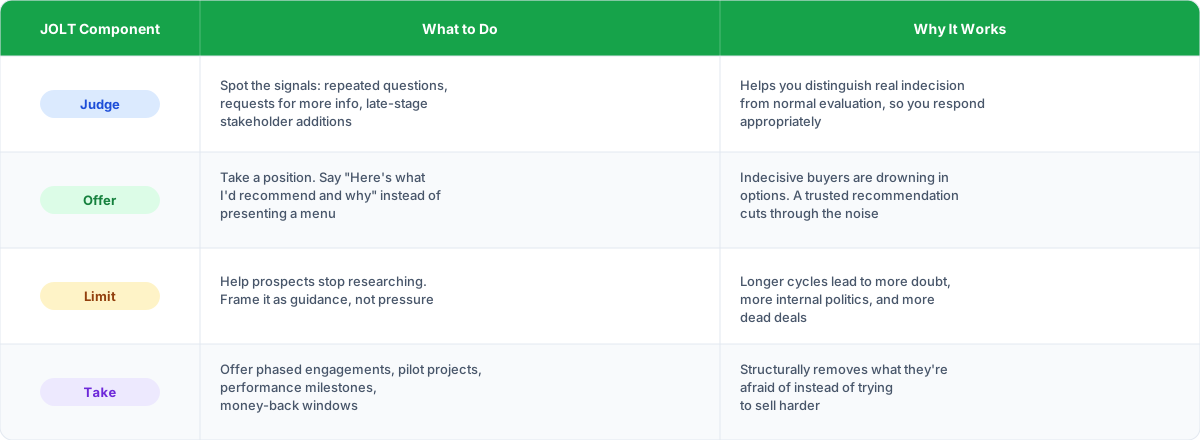
J: Judge the level of indecision
Not every stalling prospect is indecisive. Some are genuinely evaluating. Some are waiting on budget approval. Some are just busy. But some are truly stuck, paralyzed by the fear of making the wrong choice.
You need to be able to tell the difference.
The signals of real indecision are: asking the same questions repeatedly, requesting "just a little more information" that never seems to be enough, looping in new stakeholders late in the process, and wanting to "revisit the timeline" after you thought terms were agreed.
When you spot these patterns, the worst thing you can do is keep pitching harder. More case studies. More emails. That's pouring gasoline on the fire. What they need isn't more information. They need less fear.
O: Offer your recommendation
Indecisive buyers often drown in options. They've looked at five agencies. They've read twenty case studies. They've had a dozen internal conversations.
And all that research has made them more confused, not less.
BrightLocal's 2026 data supports this: 70% of consumers who read reviews still regretted a purchase afterward. More information doesn't always equal better decisions.
Sometimes it equals more anxiety.
Your job is to cut through the noise. Don't present three options and say, "Let me know which works best." Say, "Based on what you've told me, here's what I'd recommend and why." Take a position. Be direct. Indecisive buyers don't need another menu. They need someone they trust to say, "This is what you should do."
L: Limit the exploration
This sounds counterintuitive, but you should actually help your prospect stop researching. When a buyer says, "We want to look at one more agency before deciding," the instinct is to say, "Of course, take your time." But every week that passes, the likelihood of the deal dying increases.
HubSpot found that 28% of sales professionals say lengthy sales processes are the primary reason prospects back out. DemandGen confirms the trend: 68% of B2B buyers say their purchase cycles have gotten longer. Longer cycles don't lead to better decisions. They lead to more doubt and more internal politics. Eventually someone says, "Maybe we should just table this for now."
You can limit exploration respectfully. Frame it as helping them: "I've seen this before. At this point, more research usually makes the decision harder, not easier. You've got great information. Let's use it." Naming the risk directly isn't pushy — it's honest.
T: Take risk off the table
This is the big one. If the core problem is fear, the core solution is removing what they're afraid of.
And this is where most agency operators have more leverage than they realize. You can structurally de-risk the engagement in ways that don't cost you much but mean everything to a nervous buyer:
- Phased engagements. Instead of a six-month retainer commitment, propose a paid discovery phase or a 90-day pilot. Let them experience your work before they commit long-term.
- Performance milestones. Build check-in points into the project where the client can evaluate results before the next phase begins.
- Money-back windows. I know this makes some agency owners cringe. But a 30-day satisfaction clause signals confidence. And clients almost never invoke it.
- Quick wins first. Structure the project so the earliest deliverables are high-visibility, fast-turnaround items. When the client sees results in week two, the fear starts to dissolve.
- Clear, documented processes. When a prospect can see exactly how you work (your onboarding steps, your communication cadence, your escalation procedures), uncertainty drops. If you want to dig deeper into how structured onboarding reduces buyer risk, our guide on client onboarding systems covers the mechanics.
The JOLT research confirmed it: taking risk off the table beat every other strategy for converting indecisive buyers. Not selling harder. Not offering discounts. Structurally removing what they were afraid of.
JOLT framework summary
How many follow-ups does it take to close an agency deal?
These numbers are embarrassing. Invesp's research shows that 80% of successful sales require five or more follow-up touch points. Meanwhile, 48% of salespeople never follow up at all. And 44% of those who do follow up quit after a single attempt.
That means 92% of sellers either never follow up or quit after one try. And 60% of customers reject an offer four times before saying yes.
Most agency owners interpret silence as rejection. It's not. It's indecision. It's fear. It's a buyer sitting on your proposal, wanting to say yes, and not quite being ready. Every day you don't follow up, the perceived risk of hiring you grows, because your prospect is left alone with their doubts.
The key is following up without being annoying. Each touchpoint should add value, not just restate "Hey, still interested?" For a complete follow-up cadence and the tactical playbook on how to do this well, see agency sales psychology.
How does economic uncertainty affect B2B buying decisions?
Something shifted in the last couple of years that every agency owner needs to understand. Economic uncertainty isn't just making buyers cautious. It's actually compressing buying cycles in unexpected ways.
6sense's 2025 follow-up survey found that 62% of buyers engaged with sellers earlier because of economic uncertainty. Not later. Earlier. Why? Because buyers with available budget are afraid it'll get clawed back.
They need to show impact faster to justify their spending. So they're accelerating purchases, not delaying them.
But there's a catch. DemandGen's 2024 data shows that 34% of buyers also report purchase delays due to budget freezes. So you've got two forces pulling in opposite directions: buyers who have budget are moving faster, and buyers whose budget got frozen are stuck.
For agencies, this means two things. First, 26% of buyers say the current environment requires more hands-on attention and engagement from solution providers (DemandGen 2024). They want you to be more responsive and more proactive. Every unanswered email, every delayed response, every vague "we'll get back to you" adds to the risk pile in their mind.
Second, time-to-value matters more than ever. When a buyer is racing to deploy budget before it disappears, they can't afford a three-month onboarding process followed by a six-month "optimization period." They need results they can point to quickly. Structure your engagements accordingly: front-load the wins, compress the timeline, show impact early.
This connects directly to agency pricing and positioning. Phased pricing is more than a risk-reduction tactic. With budget anxiety this high, it's a strategic advantage.
A $5,000 paid discovery sprint that delivers a clear roadmap and early insights is easier to approve than a $30,000 retainer commitment, even if the retainer is the better long-term value.
How do you become the low-risk choice for clients?
The truth about selling agency services is simpler than you think. Your prospects aren't choosing between you and the competition most of the time. They're choosing between you and the terrifying possibility that they'll spend real money and get burned. Again.
Every piece of friction in your sales process, every unanswered question, every vague promise, it all adds to the risk pile. And when that pile gets heavy enough, they do what 61% of lost-deal buyers do: nothing at all.
The agencies that win aren't necessarily the most talented. They're the ones that make saying "yes" feel safe.
They:
- Show their work through specific, relevant case studies (not generic "we do great work" pages)
- Are transparent about their limitations, which paradoxically makes them more trustworthy
- Offer structured de-risking: phased engagements, pilot projects, clear processes
- Follow up persistently without being pushy (and they do it five, six, seven times)
- Make the internal sell easy by giving their champion ammunition for the buying committee
- Respond quickly, communicate clearly, and never leave a prospect wondering what happens next
As we covered in the parent article on agency business psychology, understanding how clients make decisions is empathy, not manipulation. Behind every ghosted proposal is a human being who wanted to say yes and couldn't quite get there.
If you want to build the kind of organized, transparent client experience that lowers perceived risk from the very first interaction, clear processes and documented communication are the foundation.
That's what we built Sagely to do: give agency operators the systems that make the entire client relationship visible, trackable, and clear enough that buyers stop second-guessing. But the mindset shift comes before any tool. The real competition isn't other agencies — it's fear.
And fear doesn't respond to a fancier pitch deck. It responds to trust. To understand how that trust gets built long before the sales conversation, see how clients actually make decisions.
And for the tangible evidence that reduces risk on sight, read building credibility signals. When you're ready to put all of this into a repeatable sales process, agency sales psychology ties it together.
Your biggest competitor isn't the agency down the street. It's your prospect's last bad experience.
Frequently Asked Questions About Buyer Risk Perception
Why do clients ghost agencies after a great discovery call?
Usually because of buyer indecision, not a competitor win. Ebsta's 2024 data shows 61% of lost deals are attributed to buyer indecision. The prospect liked your work but couldn't overcome the fear of making the wrong choice. They chose "do nothing" because it felt safer than risking another bad vendor experience.
What is loss aversion and how does it affect agency sales?
Loss aversion means the pain of losing something is roughly twice as powerful as the pleasure of gaining something equivalent (Daniel Kahneman, Nobel Prize-winning research). When evaluating your proposal, clients weigh "what happens if this fails" about twice as heavily as "what happens if this succeeds." That's why lowering price rarely closes deals.
What is the JOLT Effect framework?
JOLT is a sales framework developed by Matt Dixon and Ted McKenna based on 2.5 million sales conversations. It stands for: Judge the level of indecision, Offer your recommendation, Limit the exploration, and Take risk off the table. It's designed specifically for converting indecisive buyers.
How does transparency affect agency sales?
Counterintuitively, being honest about your limitations makes you more influential. TrustRadius found that vendors who were upfront about limitations were 2x more likely to be rated "very influential" during the buying process. 85% of vendors think they're transparent, but only 37% of buyers agree.
How many follow-ups should agencies send after a proposal?
At least five. Invesp's research shows 80% of successful sales require five or more follow-up touchpoints. But 48% of salespeople never follow up at all, and 44% quit after one attempt. Each follow-up should add value (a relevant article, a case study, a thought about their situation), not just ask "still interested?"
What are the best ways to de-risk an agency engagement?
Offer phased engagements instead of long-term retainers. Build performance milestones with evaluation checkpoints. Structure projects so early deliverables are high-visibility quick wins. Provide clear, documented processes covering onboarding, communication cadence, and escalation procedures. Consider a 30-day satisfaction clause.
Does lowering your price help close deals?
Rarely. Clients aren't scared of the dollar amount. They're scared of the loss, the wasted budget, the embarrassment, the failed relationship. A cheaper engagement that fails still hurts. Focus on reducing perceived risk through proof, transparency, and structured de-risking instead of discounting.
Why does status quo bias kill agency deals?
Status quo bias makes people default to whatever they're already doing, even when it's clearly not working. Your prospect's current underperforming setup is familiar and predictable. Hiring you introduces unknown variables. The devil they know beats the devil they don't, unless you make saying yes feel safer than staying put.