


Agency Pricing Strategy: Stop Losing Deals Over Money
Here's a confession. I spent the first two years of my agency charging by the hour, watching clients nitpick every line item, and wondering why I was working 60-hour weeks for margins that barely covered rent.
I thought the problem was my rates. So I raised them. Clients pushed back. I lowered them.
Clients still pushed back. I tried "competitive pricing" (which is just a fancy way of saying I looked at what other agencies charged and picked a number in the middle). Nothing changed. I was stuck in the same cycle: send proposal, get questioned on price, negotiate down, feel resentful, deliver anyway.
Then a mentor told me something that rewired my entire approach to agency pricing strategy: "They're not objecting to your price. They're objecting to the risk." That one sentence changed everything about how I price, position, and present my services. And the data backs it up in ways that should make every agency owner rethink their pricing model from the ground up.
If you've read our deep dive on agency pricing psychology, you know the basics: price objections are really risk objections, value-based positioning beats hourly billing, and buyer psychology drives more decisions than spreadsheets. This article goes further. This is the tactical playbook for actually implementing those principles in your pricing, your proposals, and your positioning.
Agency pricing strategy is the system you use to set, structure, and present your prices so clients say yes without grinding you down. It covers value-based pricing, tiered packaging, proposal presentation, and expansion revenue. Done right, it turns pricing from your biggest objection into your biggest advantage.
Why are pricing objections really about risk?
Price objections are almost never about the dollar amount. They're about the client's inability to see clear ROI, justify the cost internally, or feel confident the money won't be wasted. Here's what the data actually says.
Demand Gen's 2020 research shows pricing ranks as the number two most important factor (72%) when B2B buyers evaluate solution providers, just one point behind features and functionality at 73%. Reviews came in third at 59%. So yes, price matters. But it doesn't matter the way most agency owners think it does.
But here's what matters. Showpad's data found that disagreements over price (37.96%) is the single biggest reason the B2B buying process takes longer. Not "price is too high." Disagreements over price. There's a massive difference. Disagreements over ROI (22.71%) is the second biggest delay factor. And difficulty understanding information (32.62%) slows things down even more.
Read those numbers together and the picture gets clear. The price conversation isn't about the number on the page. It's about clarity. When a client says "it's too expensive," they're really saying one of three things:
"I don't understand the value well enough"
"I can't justify this to my boss"
"I'm scared this won't work and I'll have wasted the money"
All three of those are risk problems.
DemandGen found that 70% of B2B companies now conduct detailed ROI analyses before making a final purchasing decision. They're not comparison shopping your hourly rate against some freelancer on Upwork. They're trying to figure out whether the money they spend with you will come back. And if they can't see a clear path to ROI, no price feels comfortable.
Edelman's 2025 Brand Trust Report makes this pretty clear: trust now equals price and quality as a purchase consideration. Not trails behind. Equals. That means your trustworthiness is literally as important as your rate card. If a client trusts you, more often than not, they'll find the budget. If they don't trust you, no discount in the world will get them to sign.
So the game isn't to lower your price. It's to make the value so obvious and the risk so low that the price feels like a bargain. Everything else in this article is about how to do that.
Should agencies use value-based pricing or hourly billing?
Value-based pricing charges for outcomes instead of hours, and it fundamentally changes the client relationship from cost center to investment. The switch isn't easy, but the margin improvement is dramatic.
I made the switch from hourly billing to value-based pricing after a particularly brutal experience with a client who spent 45 minutes questioning a $4,200 invoice, line by line, on a recorded Zoom call.
Every task I'd logged became a courtroom exhibit. "Why did this take 3 hours?" "What exactly were you doing for these 45 minutes?" "Can you show me what was accomplished in this block?"
That call was the wake-up. As long as I was selling hours, I'd always be on the defensive. The client wasn't being unreasonable (from their perspective, they were just trying to understand what they paid for). The model itself was broken.
When you bill by the hour, you're a cost center. The client's instinct is to minimize your hours because every minute is money out of their pocket. They start second-guessing your process. They hesitate before sending a "quick question" because they're wondering if that Slack message just cost them $50. The entire relationship becomes transactional.
When you price based on outcomes, you're an investment. The conversation shifts from "how many hours will this take?" to "what will this achieve?" And it changes the whole dynamic.
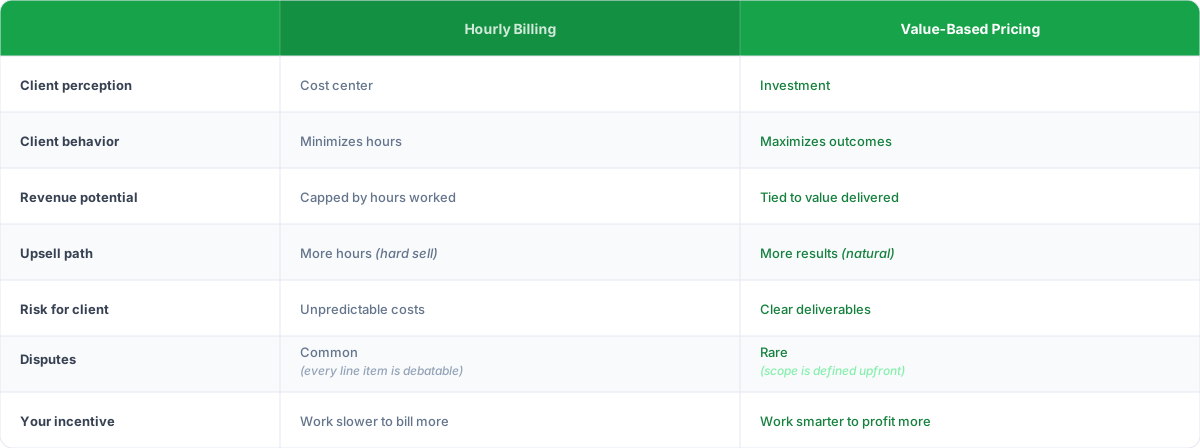
Now, I want to be honest here. Value-based pricing isn't a magic switch. It requires you to actually understand the value you deliver, which is harder than most agency owners want to admit. You can't just slap a $15,000 price tag on something that used to cost $5,000 and call it "value-based." The value has to be real, quantifiable, and communicated clearly.
But when it works? The margins change dramatically. Parakeeto's benchmarks show the average agency net profit (EBITDA) sits around 10%. That's not a lot of breathing room. Traditional agencies target 40-70% delivery margins, with 20-30% going to overhead.
If you're billing hourly and losing even a small percentage of time to non-billable work (and you are, because close to half of agencies say tracking billable time is their biggest challenge, according to AgencyAnalytics), that 10% profit margin shrinks fast.
Value-based pricing lets you decouple revenue from hours. When you deliver a conversion-optimized landing page system that generates 200 qualified leads per month, the client doesn't care whether it took you 20 hours or 40. They care about the 200 leads. And if you've gotten efficient enough to deliver that in 20 hours instead of 40, you keep the difference. That's how you go from 10% margins to 30% or more.
If you're still stuck on hourly and not sure where to start, the first step isn't changing your pricing. It's fixing your tracking. When your time logs are messy or inconsistent, you can't even calculate what value-based pricing should look like. We covered this in depth in billing dispute prevention, and it's the unglamorous foundation that makes the pricing shift possible.
How does tiered pricing psychology work for agencies?
Here's a principle that changed how I present every single proposal: when you give a client one price, their only decision is yes or no. When you give them three options, their decision becomes which one.
That's the anchoring effect at work.
The highest tier sets an anchor that makes the middle tier feel reasonable by comparison. The lowest tier exists so nobody feels pressured, but it's intentionally limited enough that most clients self-select into the middle.
I learned this by accident, honestly. A prospect asked me for a "simpler version" after balking at my initial quote. Instead of discounting, I created three packages: a basic option at 60% of my original price, my original scope at full price, and a premium option at 150% that included strategic consulting and quarterly business reviews. The client picked the middle option, which was exactly what I'd originally proposed. Same price. Zero pushback. The only difference was context.
This isn't manipulation. It's giving clients the psychological safety of choice. When there's only one number, any hesitation becomes a hard stop. With three options, hesitation becomes comparison. And comparison keeps them engaged instead of scared.
How specialists win the pricing game
Here's where positioning and pricing intersect. According to Promethean Research, 84% of agencies now identify as specialists. That number isn't an accident. Specialization doesn't just help with marketing. It fundamentally changes the price conversation.
When you're a generalist ("we do digital marketing"), the client has dozens of alternatives to compare you against. Price becomes the differentiator because they can't tell you apart from the next agency. You're a commodity. And commodities compete on price.
When you're a specialist ("we do SEO for B2B SaaS companies in the $5-50M revenue range"), the comparison set shrinks dramatically. The client isn't comparing you to every agency in the market. They're comparing you to the small handful of agencies that understand their specific world. That's a completely different conversation.
Specialist positioning lets you charge more because:
- You can speak the client's language from minute one (which addresses the "vendor knowledge of the buyer's company and needs" factor that 65% of buyers ranked as a top reason for choosing a vendor, per DemandBase)
- Your case studies are directly relevant, which reduces perceived risk
- Your process is refined for their specific challenges, which increases perceived value
- There are fewer alternatives, which reduces price pressure
The data supports this at the revenue level too. AgencyAnalytics found that roughly 66% of agencies saw revenue rise, with most experiencing increases of 25% or more. The agencies growing fastest aren't the ones cutting prices. They're the ones doubling down on positioning.
If you want to dig into how positioning, reputation, and trust signals change the sales conversation, we covered that in building credibility signals.
How should agencies present pricing in proposals?
This is the part most agency owners completely overlook. You can have the perfect pricing model, the right positioning, the ideal client. But if your proposal is a generic PDF with a price slapped at the bottom, you're leaving money on the table.
Proposify's 2025 State of Proposals report analyzed over 900,000 proposals. The findings are worth paying attention to.
- Speed matters more than you think. The average time from a proposal being sent to the prospect opening it is 75 minutes. And the average time from first open to deal closed is just 2 days. That means the window between "I'm interested" and "I've decided" is absurdly short. If your proposal isn't clear, compelling, and easy to act on, you're losing deals in that 48-hour window.
- Friction kills deals. Documents with electronic signatures close 4x faster than those without. Think about that. The simple act of requiring a client to print, sign, scan, and email back a PDF (yes, some agencies still do this) is costing you deals. Reducing friction at the signing stage isn't a nice-to-have. It's a conversion lever.
- This one surprised me. Signing the proposal yourself before sending it to the client increases close rates by 33% (Proposify 2025). Why? Because it signals commitment. It says, "I'm already all in on this. The only question is whether you are too." It's a small psychological cue, but the data says it matters.
- Get more eyeballs on your proposal. When more than one stakeholder views a proposal, close rates double. Most agencies send proposals to one person and hope that person sells it internally. Instead, ask to include the other decision-makers. Send it to the whole committee. The more people who see it, the higher your odds.
- Don't fear the revision. Proposals that get revised actually have higher close rates than proposals that go through untouched. I know, that sounds backwards. Most agency owners see a revision request and panic ("they're trying to negotiate me down"). But revision signals engagement, not rejection. It means they're taking it seriously enough to customize. Treat revision requests as buying signals, not red flags.
The IKEA effect in pricing
There's a behavioral economics principle called the IKEA Effect: people value things more when they participate in building them. Proposify's data supports this in the pricing context. Proposals with interactive pricing tables, where buyers can adjust quantities, add or remove features, and see real-time pricing changes, see higher close rates than static pricing.
Why? Because when a client builds their own package, they feel ownership over it. They're not evaluating your price anymore. They're evaluating their price, the one they chose. That psychological shift from "is this worth it?" to "this is what I picked" closes deals.
For small agencies, this doesn't mean you need fancy proposal software (though it helps). It means presenting options, not ultimatums. Let the client mix and match services. Give them clear add-ons they can include or exclude. Make them feel like they're assembling their engagement, not being handed a take-it-or-leave-it quote.
We covered this in risk perception in buying decisions: the more control a buyer has over the outcome, the less risk they perceive.
Why are existing clients your best revenue opportunity?
This number is wild: 72% of company revenue comes from existing customers, not new ones (HubSpot 2025). And 91% of salespeople engage in upselling, which adds an average of 21% to company revenue.
Most agency owners spend the majority of their energy chasing new logos. New leads. New pitches. New proposals. Meanwhile, their existing clients (the ones who already trust them, already know their process, already have budget allocated) are sitting right there, ready to expand, and nobody's asking.
The math is brutal. Acquiring a new client costs 5-7x more than retaining an existing one (Forbes, cited by AgencyAnalytics). The success rate of selling to an existing client is 60-70% versus 5-20% for a new prospect (DemandSage). Existing customers spend 67% more than new ones.
So if you want to improve your pricing economics, the fastest path isn't raising rates on new clients or restructuring your packages. It's getting better at expanding relationships with the clients you already have.
And here's where it connects to pricing psychology. When you've already demonstrated value to a client, the pricing conversation changes completely. You don't have to justify your existence. You don't have to prove ROI from scratch.
You just have to show them the next result you can deliver. That's a fundamentally easier sell.
Think about it practically. You're running content marketing for a client and delivering strong results. They mention they're struggling with email. You don't have to pitch them cold. You say, "We're already driving these leads, let's make sure they're being nurtured effectively.
Here's what an email program would look like." You're adding value to something they already trust. The risk is minimal. The decision is easy.
36% of agencies increased prices in 2024 due to rising inflation (AgencyAnalytics). But the agencies that grew fastest weren't just raising rates. They were expanding services within existing accounts. Agencies that expanded their service offerings grew 9.7% compared to 1.1% for agencies that made no changes (Promethean Research).
A practical pricing framework for small agencies
Let me tie all of this together with something actionable. If you're a solo operator or running a small team (1-10 people), here's a framework for rethinking your pricing from the ground up.
- Understand your real costs: Most small agency owners have no idea what their actual costs are. They know what they charge per hour and roughly what they spend per month. But they've never calculated their effective hourly rate (total revenue divided by total hours worked, including all the non-billable admin, sales, and communication time). Parakeeto's data says agencies lose 10-20% of gross margin annually to non-billable time, time off, and shared production expenses. If you're not accounting for that, your "profit margin" is fantasy.
- Shift from selling time to selling outcomes: Start with one service. Pick the one where you can most clearly tie your work to a measurable business result. Package it as a fixed-scope engagement with a defined deliverable and an outcome the client can measure. You don't have to convert your entire business overnight. Start with one service line as a pilot.
- Build three tiers: Structure your offering into three packages. The bottom tier should be an entry point (lower risk, limited scope). The middle tier should be your ideal engagement (the one with the best margins and the best results). The top tier should be ambitious, a premium option for clients who want the full experience. Most clients will pick the middle. The top tier's real job is to make the middle one look reasonable.
- Fix your proposal process: Based on the Proposify data: use e-signatures (4x faster close), sign your proposal before sending (33% higher close rate), include multiple stakeholders (double the close rate), and don't panic when they ask for revisions (revision signals buying intent). Give clients interactive options when possible. Let them feel ownership over what they're buying.
- Prioritize expansion over acquisition: Before you spend another dollar chasing new leads, ask yourself: have you explored every way to expand the relationships you already have? Have you asked your happy clients for referrals? Have you proposed additional services to accounts that are already performing well? With 72% of revenue coming from existing customers and 67% higher spend from repeat clients, your best "new" revenue might already be in your pipeline.
- Track everything: None of this works without data. You need to know your billable utilization rate, your effective hourly rate, your project profitability, and your time allocation. If you're still tracking this in spreadsheets (or worse, from memory), you're flying blind. And flying blind in a business with 10% average margins is a recipe for a very bad quarter.
This is where having a proper system matters. If billing disputes, unclear time tracking, or messy client communication are eating into your margins, those are operational problems that compound. Every hour spent arguing about an invoice is an hour not spent doing billable work.
Every misunderstanding about scope is a piece of margin you'll never get back. Tools like Sagely exist specifically to solve this for agency operators: clear time tracking, transparent client communication, and the operational visibility that makes accurate pricing possible.
The bottom line on agency pricing
Here's what I've learned after years of pricing services wrong and then slowly figuring it out: your pricing says more than you think. It shows whether you understand your value, whether you can communicate it clearly, and whether you've made saying yes feel safe.
The agencies that win on pricing aren't the cheapest. They're not even the most expensive. They're the ones who make the value so obvious that the price becomes a secondary consideration. They position as specialists, present options instead of ultimatums, and reduce friction at every step. And they invest in the clients they already have instead of constantly chasing new ones.
The data is clear. Trust equals price and quality (Edelman). Price disagreements are the top delay in deals (Showpad). And 70% of buyers are running detailed ROI analyses before they sign anything (DemandGen). If you can make the value visible, the risk manageable, and the process easy, pricing stops being an objection and starts being a formality.
And if you want to understand the psychology behind how clients evaluate and choose vendors, start with how clients actually make decisions. Pricing is one piece of the puzzle. The sales psychology of how you present, follow up, and close matters just as much.
Stop competing on price. Start competing on clarity.
Frequently Asked Questions About Agency Pricing
What is value-based pricing for agencies?
Value-based pricing means charging based on the outcomes you deliver, not the hours you work. Instead of billing $150/hour, you price a project at $15,000 because it will generate a measurable result like 200 qualified leads per month. This decouples your revenue from time and rewards efficiency.
Why do clients push back on agency pricing?
Most pricing objections aren't about the dollar amount. Clients push back because they can't see the ROI clearly, they can't justify the cost internally, or they're afraid the engagement won't deliver results. According to Showpad, price disagreements (37.96%) are the single biggest reason B2B deals stall.
How should agencies structure tiered pricing?
Build three tiers. The bottom tier is a low-risk entry point with limited scope. The middle tier is your ideal engagement with the best margins. The top tier is a premium option that makes the middle feel reasonable by comparison. Most clients self-select into the middle, which is exactly where you want them.
How do you write agency proposals that close deals?
Use electronic signatures (4x faster close rates), sign the proposal yourself before sending (33% higher close rate), and include multiple stakeholders (doubles close rates). According to Proposify's analysis of 900,000+ proposals, the average time from first open to deal closed is just 2 days. Make it easy to say yes.
Should agencies raise prices or focus on existing clients?
Focus on existing clients first. HubSpot's 2025 data shows 72% of company revenue comes from existing customers, and selling to an existing client has a 60-70% success rate versus 5-20% for new prospects. Expansion revenue is your fastest path to growth.
What's a good profit margin for agencies?
The average agency net profit (EBITDA) is around 10%, according to Parakeeto's benchmarks. Traditional agencies target 40-70% delivery margins with 20-30% going to overhead. Switching to value-based pricing and improving operational efficiency can push net margins to 30% or more.
How do specialist agencies charge more than generalists?
Specialists face less price competition because they serve a narrow market with fewer alternatives. Promethean Research found that 84% of agencies identify as specialists. When you deeply understand a specific industry, clients pay a premium because your expertise reduces their perceived risk.
When should agencies stop billing by the hour?
Stop hourly billing when you find yourself defending line items instead of discussing results. Start with one service line where you can clearly tie your work to a measurable business outcome, package it with defined deliverables, and test the response before converting your entire business.