


Agency CRM software is contact and pipeline management built to track prospective clients from first conversation to signed retainer. Most agencies don't pick the wrong one because they skipped the research. They pick the wrong one because most CRMs in 2026 are designed for a sales team, not an agency.
The language is different. Your "leads" are prospective clients. Your "deals" are retainers and project wins. Your pipeline has a three-week gap between first call and signed contract where you're mostly sending decks and chasing approvals. These tools were built for inside sales reps hitting 50 calls a day.
The question isn't which one tops the list. It's which one fits how agencies win clients. Here are six worth a serious look.
HubSpot CRM: The all-in-one platform that rewards commitment

Best for: Mid-size agencies that want CRM, email marketing, and reporting under one roof, and are prepared to pay for it.
HubSpot's free plan is genuinely useful. Contact management, deal pipelines, email tracking: real features, not a demo. If you're a small agency building pipeline discipline, you can run on the free version for a while before you hit a ceiling.
The ceiling, when you hit it, is steep. Moving from Starter ($15/seat/month) to Professional ($90/seat/month, 5-seat minimum) is a $450/month commitment. Most agencies hit this threshold faster than expected because meaningful automation and custom reporting both sit behind the Professional gate.
Where HubSpot earns its price: the ecosystem. You get a full marketing automation suite and 1,500+ native integrations. There's also a Solutions Partner Program for agencies that resell or run HubSpot for clients. If that's your model, the economics shift considerably.
The main frustration: HubSpot is built for a single business. Multiple client accounts means a separate portal per client, and costs compound. G2: 4.4/5 (10,000+ reviews), Capterra: 4.5/5.
Pipedrive: The sales CRM agencies use
Best for: Agencies with a dedicated new-business function that needs clean pipeline management without a lot of overhead.
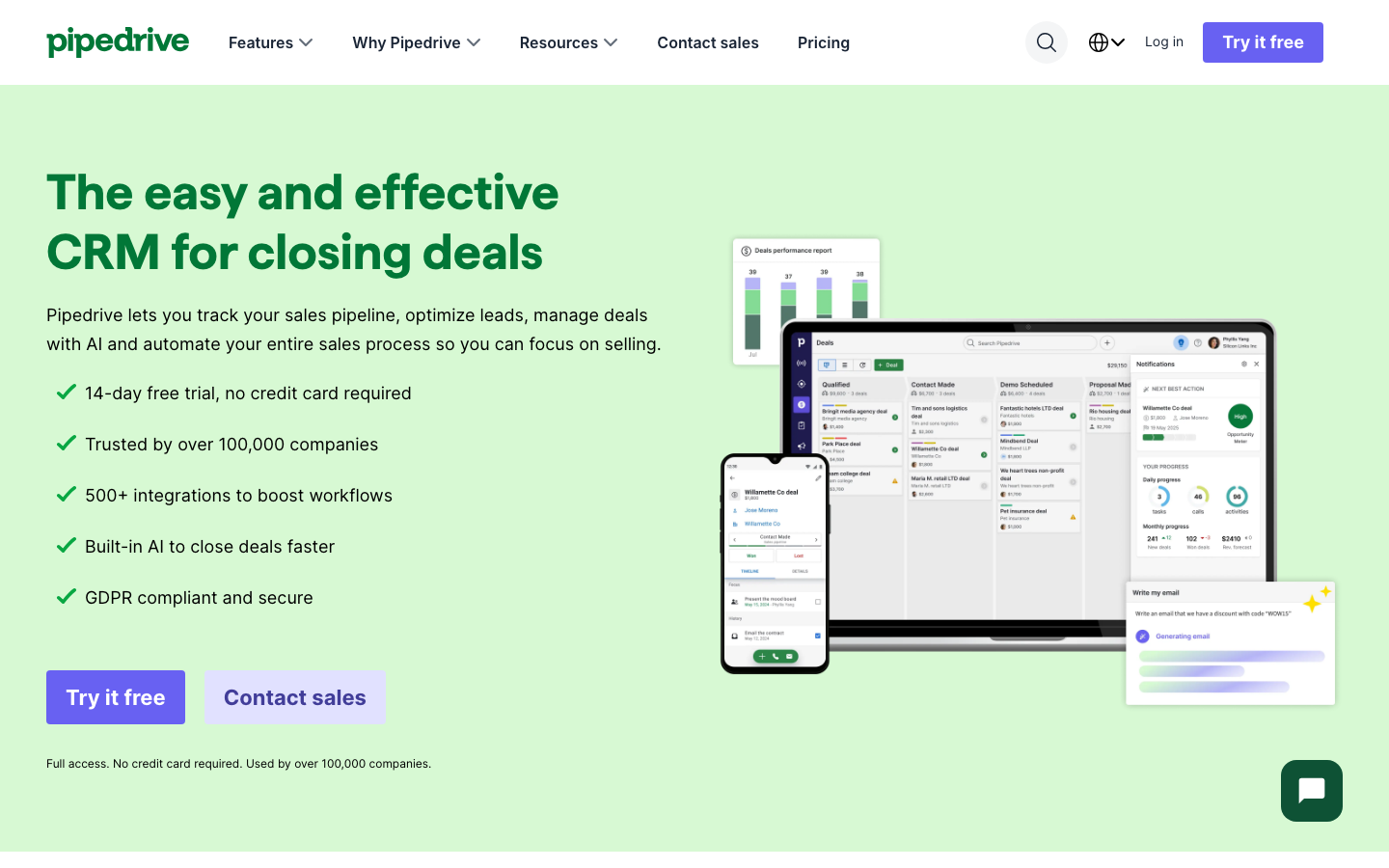
Pipedrive does one thing well: it makes managing a sales pipeline feel fast. The kanban deal view is clean and visual. You see every live opportunity, drag deals between stages, and know exactly where each prospect stands.
Plans start at $14/user/month (annual), no free plan. Add-ons for email campaigns, chatbots, and web visitor tracking are paid separately, so the entry price can escalate.
The core limitation: Pipedrive is a sales CRM, not a marketing platform. It doesn't replace email marketing or campaign management tools, and you'll need both. Reporting is basic at lower tiers: meaningful forecasting requires Professional ($49.90/user/month) or above. G2: 4.3/5 (3,000+ reviews), Capterra: 4.5/5.
Salesflare: The CRM that fills itself in

Best for: Small B2B agencies under 25 people who are tired of manually updating a CRM that nobody uses.
Salesflare's core promise is zero data entry. It pulls from email, calendar, and LinkedIn to build contact timelines automatically, logging meetings and tracking opens without manual input. If your biggest CRM problem is that the team doesn't update it, Salesflare removes that problem.
Growth plan starts at $29/user/month (annual). Pro at $49/user/month adds multi-step email sequences, custom dashboards, and email finder credits.
The ceiling is real. Salesflare shows limits when you need complex multi-team workflows or deep reporting. Reviewers who outgrew it usually moved to HubSpot. For small B2B agencies doing outbound, it earns some of the best ratings in its category. G2: 4.8/5 (300+ reviews), Capterra: 4.7/5.
HoneyBook: Client lifecycle management for creative agencies

Best for: Solo operators and micro agencies in creative fields who need proposals, contracts, invoices, and client comms in one place.
HoneyBook isn't a traditional sales CRM. It's a client operations tool covering the full arc from first inquiry to final payment: proposals, contracts, e-signatures, invoices, and payment collection. If you're currently managing this across Google Docs, DocuSign, and email threads, HoneyBook consolidates it.
Plans start at $36/month (Essentials: $49/month, Premium: $109/month). Prices jumped hard in early 2025, roughly doubling the Starter tier. Review sentiment reflects genuine frustration about this.
The limitation at agency scale: there's no real sales pipeline. No lead scoring, no pipeline analytics, limited contact segmentation. It's built for managing client relationships after the win, not for tracking how you got there. G2: 4.4/5 (500+ reviews), Capterra: 4.7/5.
monday CRM: Maximum flexibility for teams already in the monday ecosystem

Best for: Agencies that use monday.com for project management and want to keep their CRM in the same workspace.
monday CRM's whole pitch is flexibility. You get custom pipelines and multiple views (kanban, list, Gantt, timeline). The no-code automation engine can trigger on almost any condition, so non-standard sales processes don't need workarounds.
Basic starts at $12/seat/month (annual, 3-seat minimum), Standard at $17, Pro at $28. Pro unlocks sales forecasting, full analytics, and 25,000 automations per month. As teams grow, per-seat pricing becomes a recurring complaint.
The honest limitation: monday CRM started life as a project management tool adapted for sales, and it shows. Lead scoring and email sequences feel secondary, not core. Email integration is functional but draws mixed reviews. G2: 4.6/5 (700+ reviews), Capterra: 4.5/5.
Zoho CRM: The most features per dollar, if you earn them
Best for: Budget-conscious agencies with technical confidence who need deep customization without enterprise pricing.
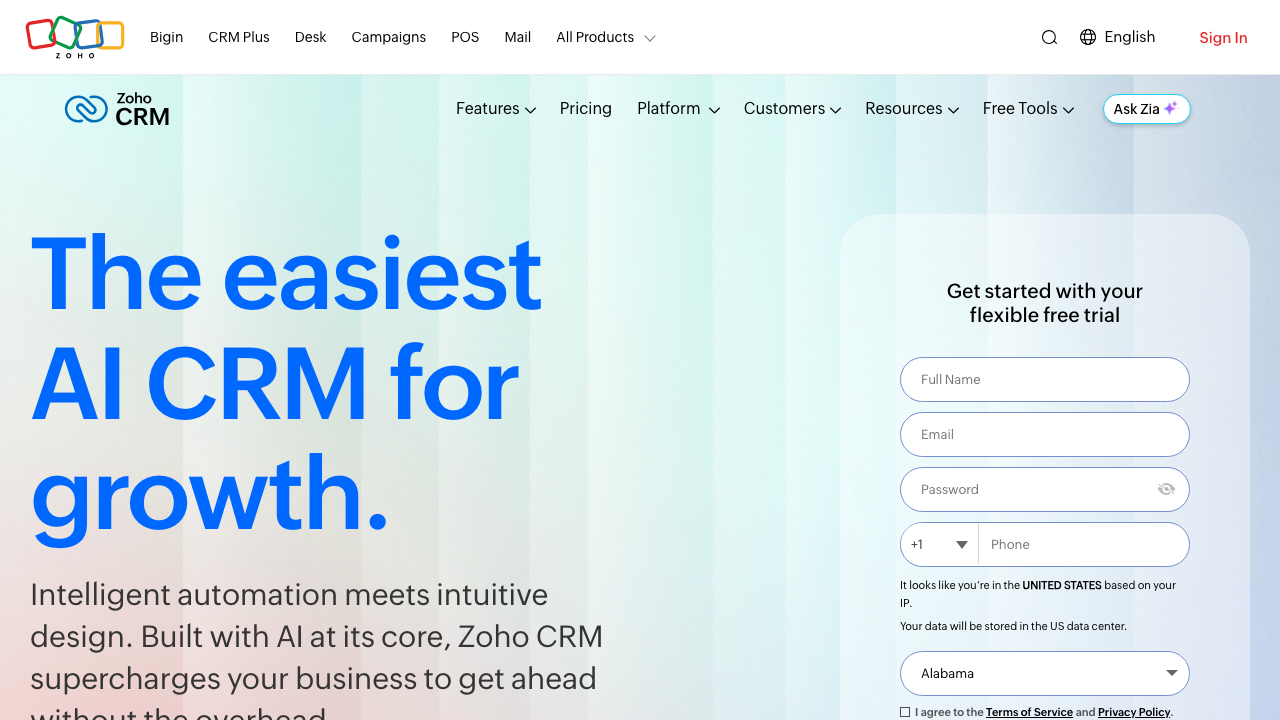
Zoho CRM's value proposition is straightforward: more features for less money than most alternatives. At $40/user/month (Enterprise, annual), you get AI-powered lead scoring via Zia, a drag-and-drop interface builder, workflow automation, sandboxing, and advanced analytics. That depth at that price is genuinely competitive.
The real cost is time. Zoho's learning curve is the most-cited frustration. Initial setup takes weeks, not days, and support at lower tiers (Standard: $14/user/month, Professional: $23/user/month) is mixed. Reviewers who left typically cite UI complexity, not missing features.
The payoff for agencies that commit: the Zoho ecosystem. Native integrations with Zoho Campaigns, Zoho Social, Zoho Analytics, and 50+ other apps. For agencies willing to go deep, the coherence is a real advantage. G2: 4.1/5 (2,800+ reviews), Capterra: 4.3/5.
How to choose the best CRM for your marketing agency
This depends less on feature lists and more on where your agency spends its time.
Solo creative or two-person studio: HoneyBook professionalizes your client operations without requiring a full CRM mindset. You'll likely outgrow it, but it's the right fit while you're small.
Small B2B agency doing outbound email and nobody's updating the CRM: Salesflare. The automated data entry is the whole value proposition.
Dedicated new-business team that needs clean pipeline visibility: Pipedrive. Best usability at its price point. You'll want a separate email marketing tool, but the pipeline itself is excellent.
Wanting one platform for marketing, sales, and reporting: HubSpot. Budget for Professional from the start. The free plan is a useful entry point, but it's also a funnel into a much bigger spend.
Already using monday.com across the agency: monday CRM is the obvious choice. If you don't already use monday, the learning curve probably isn't worth switching for the CRM alone.
Technical team, cost-sensitive, willing to invest in proper setup: Zoho CRM gives you the most features per dollar in this group. Block out real time for onboarding or it won't stick.
For more on how CRM fits agency operations, see Crm For Agencies.
Frequently Asked Questions
What is the best CRM for a digital marketing agency?
There is no single answer. HubSpot suits mid-size agencies that can budget for Professional. Salesflare fits small B2B agencies doing outbound. Pipedrive is the cleanest pipeline tool at its price point. Start with your biggest sales bottleneck, then choose.
Is HubSpot good for marketing agencies?
Yes, with caveats. The free plan works for early-stage pipeline building, and Professional earns its price for agencies that also sell or run HubSpot for clients. Costs escalate fast, and managing multiple client accounts requires separate portals, which adds up.
What CRM do small agencies use?
Small agencies commonly use HubSpot Free, Salesflare, or HoneyBook depending on their model. B2B agencies doing outbound tend toward Salesflare. Creative solos prefer HoneyBook. Agencies already on monday.com often stay with monday CRM to avoid switching costs.
Do I need a CRM as a digital marketing agency?
Yes, if you are actively developing new business. Without one, follow-ups get missed and pipeline visibility disappears. A free HubSpot account adds enough discipline to matter. The cost of one lost retainer far exceeds the cost of any tool on this list.
What a CRM won't do
Once you've signed the client, a CRM won't manage the relationship. That's where tools like Sagely come in. It's a client management platform built for agencies. Clients get a branded portal.
Feedback and approvals run through structured workflows instead of email chains. Communication stays in one place instead of scattered across Slack and inboxes.
See how it works at getsagely.co. For the post-sales side of client management, Client Portals For Agencies covers what a client portal adds to the mix.