


Picture this: an agency founder is twenty minutes into a discovery call. The prospect is engaged, asking smart questions, and the conversation has gone well. Then comes the question every founder dreads: "Can you just send me your rates?"
The founder says they'll put together a custom proposal. The prospect says sounds good. Two weeks later, nothing. A follow-up email goes unanswered. The deal is dead.
The founder will tell themselves it was a price issue. It probably wasn't. Without a rate card to send, the prospect moved on because the agency looked like it hadn't figured out its own business. When you can't answer a basic pricing question without a two-week turnaround, it signals uncertainty.
Clients pick up on that. This is the rate card problem. It's not a pricing problem. The founder knew what they wanted to charge. They just hadn't built the document that makes them look like they mean it.
A rate card gets you to a signed contract faster. It anchors pricing conversations, filters out prospects who can't afford you, and gives clients something concrete to react to. But it only works if you've actually built it, not if you're improvising numbers on every call.
This article covers exactly what to put in your rate card, how to structure it, and what to leave out. If you haven't settled on your pricing model yet, start with the companion piece on agency pricing strategy first. This article assumes you already know what you charge. You just need to package it.
What a Rate Card Actually Is (and What It Isn't)
A rate card is your agency's pricing menu. It lists what you sell, how you price it (hourly, per project, or monthly retainer), and what the numbers look like. It's a document you send to prospects, reference during proposals, and update when your rates change.
What it is not, and this matters:
It's not a proposal. A proposal is custom. It's written for a specific client, scoped to their specific situation, and usually includes a timeline and deliverables breakdown. A rate card is standard. Same document, every prospect.
- It's not a contract. A rate card doesn't bind anyone to anything. It's informational. The contract comes later, after the client decides they want to move forward.
- It's not a public price list. Most agencies share their rate card selectively. It goes to qualified prospects, not on the homepage. Posting your full rate card publicly invites race-to-the-bottom comparisons and gives competitors a free look at your pricing structure.
The rate card's job is to anchor the pricing conversation. When a client asks what you charge, you send the rate card.
Then you have a real conversation instead of making up numbers under pressure. It also filters prospects early. If a client sees your monthly retainer starts at $3,000 and they were budgeting $500, that mismatch surfaces before you spend two hours on a discovery call together.
What to Include in Your Rate Card
Most agency rate cards are either too sparse (just a list of numbers with no context) or too cluttered (trying to document every possible scenario). Here's what actually needs to be there.
- Agency details. Name, logo, contact information, and two dates: the effective date and a "valid until" date. The valid until date is often skipped, but it matters. It gives you a built-in reason to update the document regularly and signals to clients that your pricing is current, not something you printed in 2021 and forgot about. Aim to refresh it at least twice a year.
- Service descriptions. Not just service names. What each service actually includes, and where the scope ends. "SEO" is meaningless. "Monthly SEO: technical audit, eight optimised pages, four link placements, monthly performance report" means something. This is where most rate cards fall apart. Vague descriptions invite mismatched expectations, scope creep, and renegotiation conversations that shouldn't need to happen.
- Unit pricing. Whether each service is billed hourly, per project, or monthly. Be explicit. If you use "starts at" pricing (which is fine for variable-scope work), explain briefly what drives the variation. "Web builds from $5,000, depending on number of pages and integrations" is honest and sets realistic expectations. "Starting at $5,000" with no context invites the client to assume the low number is what they'll pay.
- Retainer packages. Bundled options, typically three tiers, that make it easier for clients to make a decision. Retainers protect your revenue predictability and tend to be more profitable than project work over time. Put these front and centre, not buried at the bottom after a long list of hourly rates. More on structure in the next section.
- Add-on services. Items that aren't included in core packages but are available: rush delivery, extra revision rounds, one-off audits, additional platform setups. Listing these explicitly does two things. It shows clients what's possible, and it prevents scope creep. If you don't list it as an add-on, clients will assume it's included.
- Exclusions. What you don't cover: ad spend, third-party software subscriptions, stock photography, travel costs, paid media fees. Be specific. Every item you leave off this list will be assumed to be included by at least one client. "Ad spend is paid directly by the client to the platform" is a one-line sentence that has saved agencies thousands in awkward billing conversations.
- Payment terms. Net 30, deposit percentage (50% upfront is standard for project work), late payment fees, and minimum contract length for retainers. This is routinely left off rate cards and then becomes an uncomfortable conversation at the contract stage. Put it in the rate card. Clients expect professionalism, and payment terms are part of that.
How to Structure Your Pricing Tiers
This is where most agencies get it wrong. They list every service at an hourly rate and call it a rate card. That's a contractor sheet. It's useful, but it's not an agency rate card.
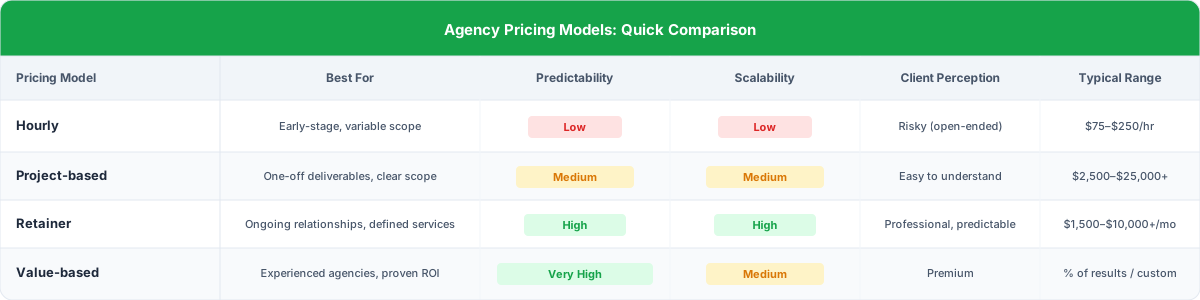
The structure that works across most agency pricing models: lead with retainer packages, then show à la carte options, then hourly rates as the fallback for genuinely undefined scope.
- Lead with retainer packages. Retainers are your most predictable, most profitable revenue. They should be the first thing a client sees. Three tiers is the sweet spot: a starter option that covers the basics, a growth option that's the right fit for most clients, and a scale option for clients who want full coverage. Name them something that communicates trajectory: Starter / Growth / Scale, or Core / Pro / Enterprise. Plan A / Plan B / Plan C communicates nothing.
- Include scope with each tier. Don't just list a price. Show what's included: which services, how many channels, how many deliverables per month, how many hours. Clients aren't buying a price point. They're buying a defined scope of work, and they need to be able to picture what they're getting.
- Show project pricing as a range. For one-off work, "website projects from $5,000" tells the truth without locking you in to a number before you've seen the brief. It's honest and it filters out clients who can't afford you before you've invested time in a scoping conversation. Based on current market rates, website redesigns typically run $5,000 to $25,000 or more for established agencies, and branding projects run $2,500 to $15,000 depending on scope.
- Show hourly rates as the custom option. Hourly billing exists for consulting, advisory work, and situations where scope genuinely can't be defined upfront. It shouldn't be the default. When hourly rates are the first thing a client sees, they immediately start doing mental arithmetic about every hour you spend on their account. That's not the relationship you want.
Based on industry data, current rate benchmarks for US-based marketing agencies in 2026: SEO runs $100 to $250 per hour or $1,500 to $10,000 per month on retainer. Paid media (PPC and Meta) runs $100 to $250 per hour or $1,500 to $8,000 per month.
Social media management runs $75 to $200 per hour or $1,000 to $5,000 per month. Content creation runs $80 to $180 per hour. Strategy and consulting runs $150 to $350 per hour. Web development runs $120 to $250 per hour or $3,000 to $75,000 per project depending on complexity.
Your rate card doesn't need to show every possible number. It shows the structure and gives enough information to anchor the conversation. The goal is a prospect who can read your rate card, understand what they'd be getting, and have a realistic sense of what it will cost before they get on a call with you.
How to Present a Rate Card to Clients
- Send it early. Not after a two-hour discovery call. In response to the initial inquiry. When a prospect fills out your contact form or sends an email asking about your services, send the rate card with your reply. This filters out clients who can't afford you before either party invests time in a relationship that won't go anywhere.
- Send it as a PDF. Not a Google Doc link. Not a shared link they can edit or that might display differently on their device. A PDF with your branding, presented like a professional document. Presentation matters. A rate card that looks polished signals that your agency operates that way too.
- Don't apologise for your rates. If you've been doing agency sales for more than a year, you've probably caught yourself doing this: opening a pricing email with some version of "I know this might seem like a lot" before the client has even reacted. It's a reflex, and it signals uncertainty before the conversation has started. Just send the rate card. If a client pushes back on price, that's a conversation to have. But you don't need to pre-empt it with an apology.
- Use it as an anchor. When you move from initial inquiry to proposal stage, reference the rate card explicitly. "As you'll have seen in our rate card, our Growth retainer covers X, Y, and Z. For your account specifically, we'd recommend..." This keeps the pricing conversation grounded in your standard rates rather than starting fresh with every proposal.
- Update it at least twice a year. If your rates have changed, your service mix has shifted, or your team has grown into new capabilities, your rate card needs to reflect that. An outdated rate card (especially one with an old "effective date") undermines the professional impression you're trying to make. Put a calendar reminder for January and July. It takes an afternoon.
- On public vs. private. Most agencies don't post their full rate card publicly, and that's fine. The most common approach is to share it in response to inquiries. Some agencies post a "starting from" number publicly and share the full card after a brief introductory call. Either works. What doesn't work is having nothing to send when a prospect asks.
📥 Free Download: Marketing Agency Rate Card Template
The complete fillable rate card — core services pricing, retainer packages, add-on rates, exclusions, and payment terms — is available as a free fillable PDF built for digital marketing agencies.
Download the Marketing Agency Rate Card Template →
Frequently Asked Questions
What should a marketing agency rate card include?
A complete marketing agency rate card should include your agency name and contact details, a list of services with clear scope descriptions, unit pricing (hourly, per project, or monthly retainer), retainer package tiers, add-on services, exclusions such as ad spend and third-party software, and payment terms. Aim for two to three pages, not a wall of text.
How much do marketing agencies charge per hour?
Based on industry data, US-based marketing agencies typically charge $75 to $350 per hour depending on service type and agency size. SEO and paid media specialists run $100 to $250 per hour. Strategy and consulting sits at $150 to $350 per hour. Social media management and content creation tend to be at the lower end, from $75 to $180 per hour.
What is the difference between a rate card and a proposal?
A rate card is a standard document showing your agency's services and pricing. It's the same document sent to every prospect. A proposal is custom: written for a specific client, scoped to their situation, and typically includes a timeline, deliverables breakdown, and project-specific costs. The rate card informs the proposal rather than replacing it.
Should I share my rate card publicly?
Most agencies don't publish their full rate card, and that's a reasonable choice. The most effective approach is sharing it in response to inquiries. Posting publicly invites price comparisons before you've had a chance to establish value. Some agencies post a "starting from" number on their website and share the full card after a brief introductory call.
How often should I update my rate card?
At minimum, twice a year. A practical schedule is January and July. Update it whenever your rates change, your service mix shifts, or your team has grown into new capabilities. An outdated rate card with a stale effective date undermines the professional impression you're trying to make. It takes an afternoon to update.
Getting your rate card right takes the awkwardness out of the pricing conversation. Once a client signs, though, the real work starts: delivering on what you promised, keeping communication clean, and managing the relationship so they stay past the first project.
That's where most agencies leak clients, not at the sales stage but at the delivery stage. If you want to see how agencies are handling that, client portals for agencies is the right next read. Or take a look at Sagely, a client management platform built for exactly this.