


Retainer management software
You send an invoice at the end of the month. The client comes back and says the hours seem high. You know the work got done.
You know the team put in the time. But now you're in that uncomfortable position where you're scrambling to prove it, pulling together Slack messages, checking spreadsheets, cobbling together some kind of audit trail that you didn't think you'd need because you assumed everyone trusted each other.
And here's the humiliating part: even when you can prove it, the relationship takes a hit. Because the client feels like they had to ask. And you feel like you had to defend your own team. Nobody wins that conversation. The work was done and yet you're spending an hour on damage control for a $200 billing dispute.
That's the retainer problem nobody talks about. It's not the work itself. Most agency owners are good at the work. It's the infrastructure around the work. The tracking. The visibility. The proof. The moment a client feels like they might be getting nickel-and-dimed, even if they're not, trust erodes. And once trust starts going, retainer clients start shopping around.
Spreadsheet-based retainer tracking is where most agencies start. You build a Google Sheet, maybe a Notion page, give clients a view-only link they never actually open. You log hours manually (sometimes). You update it when you remember to. And for the first few clients it's fine, maybe. But then you're managing six retainers and someone on your team forgot to log last Thursday and now the numbers are off and you can't figure out by how much.
The spreadsheet system isn't a system. It's a liability dressed up as a system. And the agencies I've seen scale past that phase are the ones who treated retainer visibility as a client relationship feature, not just an internal ops task.
That's what this article is about. I'm going to walk through what actually matters in retainer management software, then review five tools honestly, including their weaknesses, and tell you who each one is actually right for.
What to Look for in Retainer Management Software
When evaluating retainer tracking software, prioritize client-facing hours visibility, ticket-level time attribution, rollover rules, and flat pricing. Those four things separate tools built for agency retainer management from generic project management software with a time-tracking tab bolted on.
Most articles in this space give you a feature checklist and call it done. Features without context aren't that useful. Here's what actually matters, and why.
Client-facing hours visibility
This is the most important feature in any retainer tracking software. Your clients need to see their retainer balance without emailing you. Not a PDF you send at the end of the month. Not a Notion doc with a view-only link. An actual live view that updates as work happens. Clients who can check their own balance stop sending "how many hours do we have left?" emails. In my experience that category of check-in drops almost entirely once the portal is live.
When clients can see hours in real time, something interesting happens: billing disputes almost completely disappear. Not because clients trust you more (though that's part of it), but because there are no surprises. They've been watching the balance the whole time. They know the invoice is coming. They've already mentally accounted for it.
Ticket-level time attribution
Logging hours against a project is fine for basic billing. But if you're running a proper retainer, you want time attributed to specific requests or tasks. This does two things: it helps you understand where your team's time is actually going (scoped work tends to drift), and it gives clients the granular view they occasionally want without you having to manually explain it.
Rollover rules
Not every retainer is use-it-or-lose-it. Some agencies roll over unused hours. Some cap at a certain amount. Whatever your policy is, your software needs to handle it automatically. Because manually adjusting a rollover calculation every month is exactly the kind of admin that makes you feel like you're working for your tools instead of the other way around.
If you don't have a retainer agreement with clear rollover terms documented yet, sort that out before picking software. A free retainer contract template can save an awkward conversation mid-engagement.
Client portal that clients actually use
This is a bigger deal than most people realize. A client portal is only valuable if clients log in. Most portals fail here because the login experience is terrible. Clients forget passwords. They get frustrated. They just email you instead. The best retainer tools solve this with frictionless access (more on that when we get to Sagely).
Billing integration or clean export
I'm not going to pretend most agencies are ready to combine their project management and invoicing in one tool. Most aren't. But your retainer tool should at least give you clean export data (hours by project, by task, by client) that plugs into whatever you're using to bill. If it can't do that, you're going to spend an hour every invoice cycle translating data manually.
The 5 Best Retainer Management Tools for Agencies
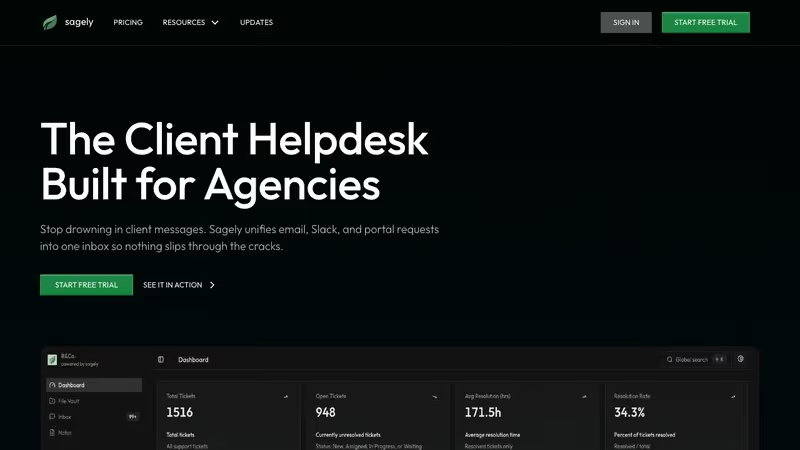
The thing that makes Sagely genuinely different from most tools in this space is the client portal login experience. Instead of passwords, clients get a one-time passcode sent to their email. They click the link, they're in.
No account to remember, no password reset, no friction. It sounds like a small thing until you've watched a client give up on logging into a portal three times in a row and go back to emailing you for everything. The OTP login is why clients actually use the portal. And a portal clients use is worth ten times one they don't.
The Kanban board lets you manage client requests visually. Clients can submit tickets, you move them through a workflow, and time gets logged at the task level. Retainer balance updates in the client's view as you log hours. There's no separate conversation needed about where the hours went. They can see it.
Sagely also supports file sharing and branded portals with custom domains and your logo, which matters if you're running a white-labeled service. Your client sees your brand, not a generic SaaS interface.
Pricing: is flat rate. Not per-seat. There's even a solo plan for freelancers and one-person shops managing a handful of retainer clients. That alone makes it unusual in this market.
Weaknesses: Sagely is a newer product. If you're looking for deep integrations with every billing tool on the market, you'll find it's still building that out. The feature set is focused, which is also its strength, but if you need something with extensive automation workflows or advanced reporting, you might feel the constraints. That said, for the core job (managing retainer clients, giving them visibility, reducing billing drama) it does exactly what it promises.
Best for: Agencies running 3 to 15 retainer clients who want a dedicated tool that doesn't require weeks of setup and won't nickel-and-dime you on seats.
ManyRequests
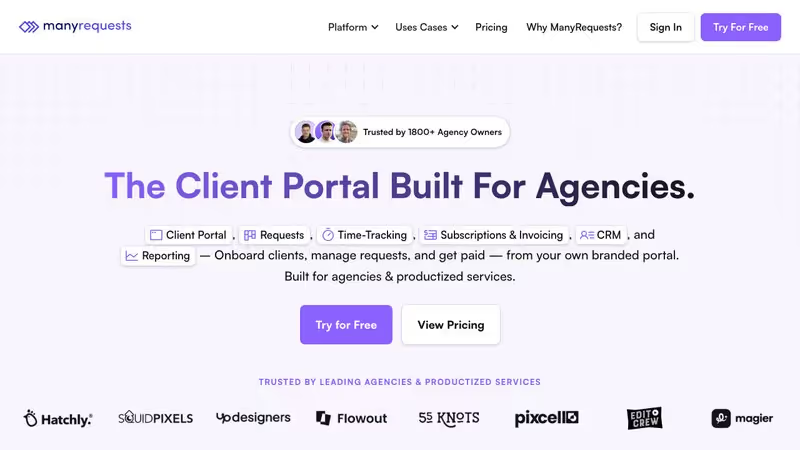
ManyRequests is one of the better-known tools in the agency software space and it's genuinely good at what it focuses on: request management. If your agency runs on a high volume of incoming client requests and you need a clean intake system, ManyRequests handles that well.
The retainer tracking is there, but it feels secondary to the request workflow. Clients can submit requests, you can manage them, and you can bill against a retainer. But the client-facing retainer visibility isn't as front-and-center as you'd want if reducing billing disputes is your main goal. Clients don't get a clear, always-updated picture of their balance the way they do with Sagely.
The bigger issue for growing agencies is the per-seat pricing model. Each client who gets portal access counts. If you're onboarding a client with a team of three people who all want visibility, you're paying for three seats. Multiply that across eight or ten clients and the math starts to sting. It's not unreasonable pricing, but it's variable in a way that makes forecasting your ops costs harder.
The interface is polished. Setup is relatively quick. The brand customization options are solid. ManyRequests has clearly invested in making the client-facing experience feel professional.
Weaknesses: Per-seat pricing, retainer visibility is functional but not a core priority in the product design. The tool is better optimized for request intake than for the billing conversation.
Best for: Agencies where high-volume request management is the primary pain point and retainer tracking is a secondary need. Works well for productized services.
Agency Handy
Agency Handy is one of those tools that's trying to do everything for agencies. Project management, CRM, invoicing, retainers, client portals, time tracking. The feature breadth is real. If you want a single tool to run your whole agency, Agency Handy is making a serious attempt at being that.
Retainer tracking exists inside Agency Handy, but it's one feature among many. And this is the core tradeoff with broad-scope tools: when a product is optimizing for coverage across many use cases, specific features tend to be less refined than a purpose-built tool. The retainer tracking works, but the client-facing experience around it isn't as clean or intuitive as I'd want if retainer billing was my main challenge.
Setup time is higher than other tools on this list. There's a lot to configure because there's a lot the tool can do. If you have the patience for onboarding and a clear picture of how you want your agency to work, it can pay off. But agencies that need to be up and running in a day or two will find Agency Handy's setup curve frustrating.
Weaknesses: Feature sprawl makes it harder to master. Retainer tracking isn't the product's primary identity, which shows in the UX for that specific workflow. Setup investment is high.
Best for: Agencies that want one tool to cover most of their operations and are willing to invest significant time in the initial configuration. Less ideal if retainer management is your primary pain point.
Harvest + Basecamp
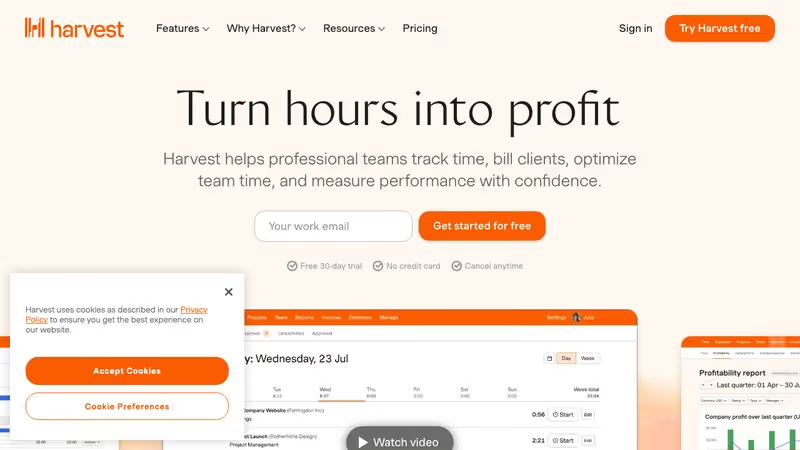
This is the combo most established agencies end up with if they started before purpose-built agency tools existed. Harvest is excellent at time tracking. Genuinely excellent. If you need accurate hour logs with team-level visibility, Harvest delivers that cleanly. Basecamp handles the project and communication side.
The problem is that together, they still don't give clients what they actually need: a single place to see their retainer status. Harvest tracks hours internally. Basecamp manages projects. But clients don't get a unified view of "here's your retainer, here's what's been used, here's what's left." They get emails. They get exported CSVs. They get a Basecamp message thread where someone summed it up.
Project management software being asked to double as a client portal isn't a client portal — it's a workaround.
Both tools have been around long enough that they're reliable and well-supported. The integrations are solid. If you're already deeply embedded in this stack and everything is working, there's no urgent reason to rip it out. But if client-facing retainer visibility is a concern, you'll be papering over the gap with manual processes forever.
Weaknesses: No unified client-facing retainer view. Two separate tools to manage and pay for. Clients are an afterthought in the portal experience.
Best for: Agencies that already use both tools and value Harvest's time tracking accuracy above everything else. Or agencies that need reporting-grade time data and can accept the client visibility gap.
Spreadsheets and Notion
I'm including this because it's what most agencies are actually using, especially in the early stages. And it's worth being honest about: for your first two or three retainer clients, a well-built spreadsheet system can work. The overhead is low, the cost is zero, and you understand how it works because you built it.
The problem isn't where you start. It's where you end up. Spreadsheet-based retainer tracking has a ceiling that you usually hit right around the time you can least afford the friction. You're managing six clients, you've got two people on your team logging hours in different ways, and someone's formula broke last month and you didn't notice until a client asked a question you couldn't answer.
You'll rebuild the system. I've talked to enough agency owners to know this is almost universal. You build a solid Notion setup or a clean Google Sheet template, it works for six months, you grow, it breaks, you rebuild. Every rebuild takes time you don't have. Every rebuild introduces new inconsistencies.
And through all of it, clients don't have a portal. They have a view-only link to a document they half-remember exists and have to know to go check. Hoping your clients are proactive enough to dig through dashboards isn't a client experience.
Weaknesses: No real client portal, scales poorly, error-prone, no automated retainer logic, your time investment compounds as you grow.
Best for: Agencies with one or two retainer clients who aren't ready to commit to a tool yet. Treat it as a starting point, not a system.
The Bottom Line: Who Should Use What
Here's how I'd think about it based on where you are right now.
If you're a solo operator or small agency with two or three retainer clients and you're just getting started, a spreadsheet isn't going to kill you yet. But be honest with yourself about when you're going to hit the wall. Most people hit it sooner than they expect and spend two weeks rebuilding something they should have replaced.
If you're running four or more retainers and billing disputes or client communication around hours is even a minor recurring frustration, that's the signal. That friction doesn't go away on its own. It gets worse as you grow. This is the moment to put a real tool in place before it becomes a retention problem.
If request volume is your primary operations challenge (lots of incoming tasks, lots of client intake), ManyRequests is worth a look. The per-seat pricing is the main thing to model out before committing, especially if your clients bring teammates into the portal.
If you want one tool to run your entire agency operations and you're willing to invest real setup time, Agency Handy is in the conversation. Just go in knowing it's a wide tool, not a deep one.
If retainer management specifically is the problem, and you want clients to actually see their hours without you sending weekly updates and answering billing questions every invoice cycle, Sagely is the most focused solution on this list. It was built for this exact problem.
The OTP login is genuinely one of those small details that changes how often clients actually engage with the portal. Flat pricing means you're not doing math every time a new client onboards.
The goal with any of these tools isn't to find the most impressive feature set. It's to remove the billing friction that makes retainer relationships fragile. Clients who feel informed and in control of their retainer spend stay longer. That's the actual business case for getting this right.
Frequently Asked Questions
What is retainer management software?
Retainer management software helps agencies track client hours, manage ongoing work, and give clients real-time visibility into their retainer balance. It's distinct from general project management tools in that it's built around the billing relationship: clients see their hours as work happens, disputes drop off, and you stop manually explaining invoices at the end of every month.
How do agencies track retainer hours?
Most agencies start with spreadsheets or standalone time-tracking tools, then run into the same problem: clients still can't see their balance without a manual update from you. Purpose-built retainer tracking software like Sagely logs hours against individual tickets and shows clients a live balance in their portal. No exports, no weekly summaries, no "how many hours do we have left?" emails.
What's the best retainer tracking software for small agencies?
For agencies managing 3 to 15 retainer clients, Sagely is the most focused option. It's built specifically for retainer management, uses OTP (passwordless) login so clients actually use the portal, and charges flat pricing rather than per-seat. ManyRequests is worth considering if high-volume request intake is your primary challenge.
Does retainer management software integrate with billing?
Most retainer tools don't handle invoicing directly, but the good ones export clean hour data you can bring into whatever billing tool you use. Sagely provides hours by client and ticket. Agency Handy has built-in invoicing if you want everything in one place. For most small agencies, a clean export is enough.
If you're running retainers and the current setup is held together with spreadsheets and crossed fingers, it's worth 10 minutes to look at Sagely's free trial. Not as a hard sell. Just because 10 minutes is a lot cheaper than the next billing dispute conversation.