
Statement of Work Template for Agencies (Free SOW PDF 2026)
Scope creep starts the moment work begins without a clear written record of what was agreed. A statement of work is the document that defines the specific work, deliverables, and timeline for a single engagement, and it is the first thing you refer to when a client asks for something that was never part of the plan.
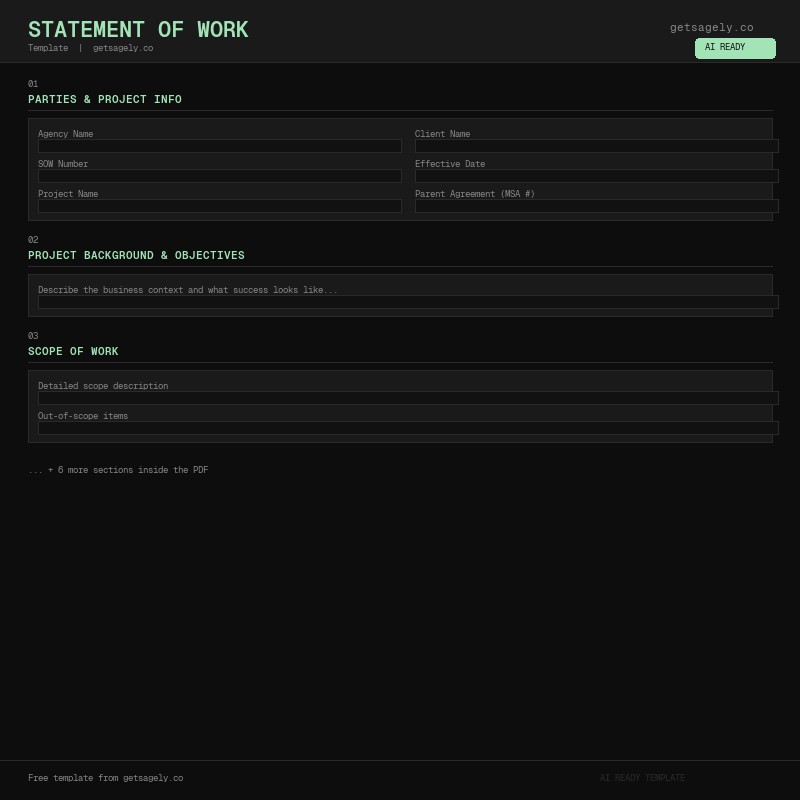
This template gives you a nine-section fillable SOW that covers every element of a project definition, from background and scope through to fees and sign-off.
What the SOW covers
The template is structured around nine sections with AcroForm fillable fields throughout, so you can complete it directly in the PDF without converting to another format.
Parties
Agency name and contact, client name and contact, and the effective date of the agreement. A SOW without clearly named parties is ambiguous by definition.
Background and objectives
A short description of the client business context and the specific objective this engagement is designed to address. Writing the background in the SOW forces the agency and client to agree on the problem definition before work begins.
Project scope
What is explicitly included in this engagement, what is explicitly excluded, and the assumptions the SOW is based on. The exclusions and assumptions sections are the highest-value parts of any SOW. They are what you reference when a client says we thought that was included. If it is not in the scope, it is not in the engagement.
Deliverables
A table of every deliverable with description, format, and due date. Naming deliverables specifically rather than describing them in general terms makes the SOW useful as a progress-tracking document throughout the project, not just a reference document at the start.
Timeline
Project start and end dates plus a milestone table with key checkpoints. Having a milestone table in the SOW rather than a separate project plan keeps the agreed timeline and the contractual document in sync.
Agency responsibilities
What the agency commits to deliver: quality standards, communication cadence, update frequency, and team members responsible for each area. Defining agency responsibilities gives clients a clear standard to hold you to, and gives you a clear basis for managing expectations when they ask for more than was agreed.
Client responsibilities
What the client commits to provide: feedback turnaround times, asset delivery, access provisioning, and approval authority. This is the section most agencies skip, and the one most responsible for project delays. When a client misses a review deadline, you can point to their responsibilities in the SOW.
Fees and payment
Total project fee, deposit amount, invoice schedule, payment due dates, and accepted payment methods. A late payment fee field is included. Having a published late fee in the SOW changes payment behaviour in a way that a verbal mention never does.
Approval and sign-off
Two-column signature block for agency and client, with date fields for both. The signature section converts a working document into a binding record of what was agreed.
Who this template is for
This template is for agency owners, project managers, freelancers, and consultants who take on project-based client work. It works for any service type: web development, design, content, SEO, strategy, or campaign delivery. If you currently rely on email chains to define project scope or have had a project derailed by scope disputes, this SOW gives you a structure that prevents those problems before they start.
How the AI-ready format works
All nine sections of this statement of work are structured so an AI assistant can read, parse, and reason over them without additional formatting. The scope definition, deliverables table, milestone table, and fee schedule are all machine-readable out of the box.
- Named bookmarks: Each of the nine sections is anchored with a bookmark, so an AI can navigate directly to the scope section or client responsibilities without scanning the full document.
- Embedded schema: The schema maps every structured field including deliverable names, milestone dates, fee amounts, and responsibility assignments, so an AI can extract and analyse engagement terms without manual parsing.
- Document metadata: The template includes metadata for document type (statement of work), service category, and engagement type, giving AI tools the context needed to flag scope gaps, compare against similar engagements, or generate change order summaries.
Try asking an AI: Are there any gaps in this SOW that could lead to scope creep? Drop in the filled SOW and ask for a risk review.
These templates are provided as examples only and do not constitute legal advice. By downloading, you agree to use them at your own discretion and accept that we bear no responsibility for how they are used.