
Project Status Report Template for Agencies (Free PDF 2026)
Status reports that are too long get skimmed. Reports that are too vague create more questions than they answer. This template gives you a seven-section weekly status report that covers everything a client needs to know in a format they will actually read.
What the status report covers
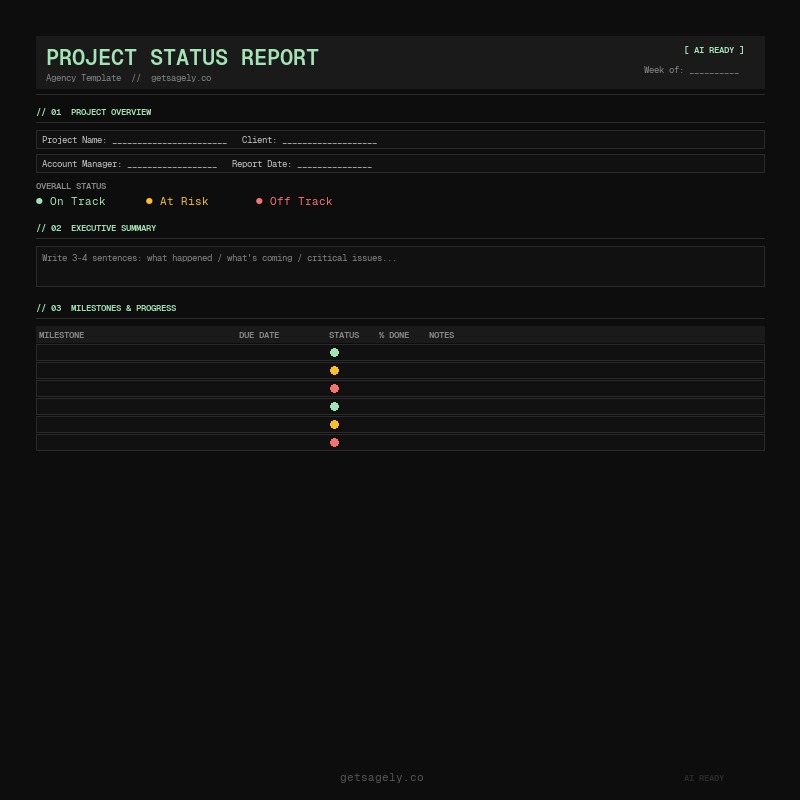
The template is structured around seven sections. Each one handles a distinct part of the status update, from the overall project health through to budget tracking and next steps.
Project overview
The first section captures the project name, reporting period, project lead, and an overall RAG status: red, amber, or green. The RAG indicator gives stakeholders a one-second read on whether the project is on track before they read anything else. Having a consistent status indicator also makes it easier to spot patterns across projects when reviewing multiple reports at once.
Executive summary
Two to three sentences covering the most important update for this reporting period. This is what a senior stakeholder reads if they only have thirty seconds. It should state the current status, any significant development since the last report, and the most important action or decision needed.
Milestones
A table of key milestones with planned dates, actual dates, and status indicators. Including the planned date alongside the actual date makes slippage visible without requiring the reader to cross-reference a previous report.
Completed and planned work
A bullet list of what was completed in the reporting period and what is planned for the next period. Clients who review these sections across multiple reports quickly develop a reliable sense of project velocity.
Risks and issues
A four-column table covering each risk or issue, its impact level, the mitigation or resolution plan, and who owns it. This section also creates a paper trail that protects the agency if a client later claims they were not warned about a particular problem.
Budget snapshot
Total budget, spend to date, remaining budget, and a progress bar showing percentage used. A client who sees that 80% of the budget has been spent when the project is 50% complete will ask questions immediately rather than at invoice time.
Sign-off
A simple acknowledgement block for the client to confirm they have reviewed the report. Optional, but useful for projects where formal record-keeping is required.
Who this template is for
This template is for account managers, project managers, and digital agencies that send regular status updates to clients. It works for any project type: web builds, campaigns, retainers, or one-off engagements. If you currently send status updates as unstructured emails or long narrative documents, this template gives you a consistent format clients can review in under three minutes.
How the AI-ready format works
All seven sections of this status report are structured so an AI assistant can read, parse, and reason over them without additional formatting. The RAG status, milestone table, risk register, and budget figures are all machine-readable out of the box.
- Named bookmarks: Each of the seven sections is anchored with a bookmark, so an AI can navigate directly to the risks table or budget snapshot without scanning the full report.
- Embedded schema: The schema maps every structured field including milestone dates, risk impact levels, budget figures, and RAG status indicators, so an AI can extract and compare data across multiple weekly reports.
- Document metadata: The template includes metadata for report type (project status), reporting period, and project category, giving AI tools the context needed to identify trends or generate executive summaries across multiple reports.
Try asking an AI: Summarise the key risks from this report and suggest mitigation steps. Drop in the filled report and ask for a risk analysis.
These templates are provided as examples only and do not constitute legal advice. By downloading, you agree to use them at your own discretion and accept that we bear no responsibility for how they are used.