
Creative Brief Template for Agencies (Free PDF 2026)
Creative work that misses the mark almost always traces back to a brief that was either vague, skipped entirely, or written so late that the team had already started. This template gives you a structured eight-section brief you can complete before any design, copy, or production work begins.
What the creative brief covers
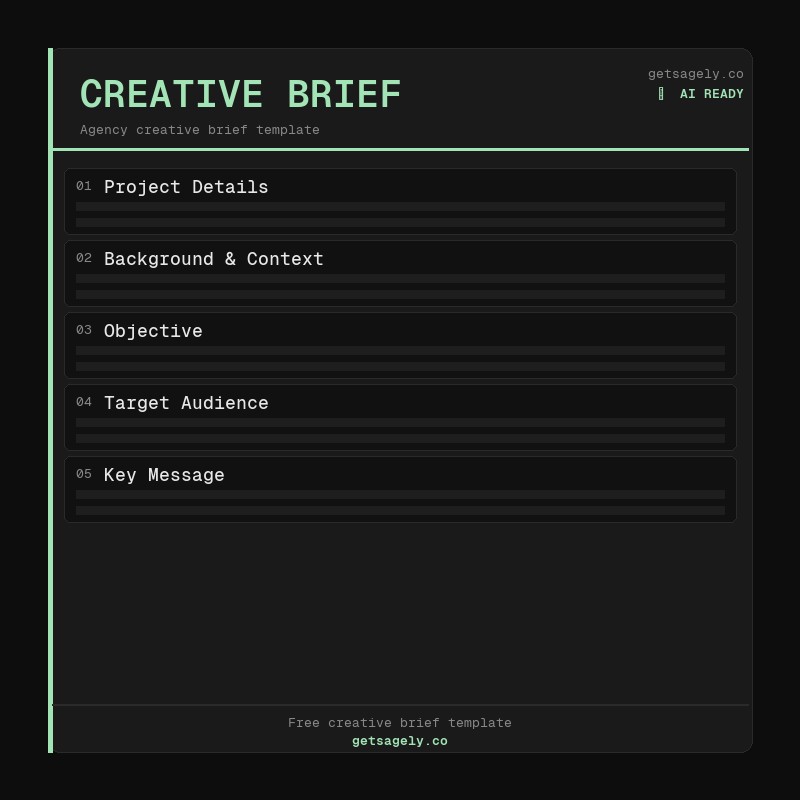
The template is built around eight sections. Each one handles a specific part of the briefing process, from the project context through to sign-off.
Project details
The first section captures the project name, client name, project lead, and key dates. It also includes space for the budget range and any linked projects or dependencies. Getting these details in writing at the start avoids the common problem of a brief that exists but cannot be found or attributed when the project is reviewed later.
Background
This section asks for the broader context: what is the client business, what problem or opportunity is this project responding to, and what has already been tried? It is the section most briefs skip, and the one that most often explains why creative work ends up in a completely different direction to what the client imagined.
Objective
A single, specific statement of what success looks like. Not a list of deliverables. The objective section asks what behaviour, perception, or outcome this project needs to produce. Teams that write create a campaign in this field produce different work than teams that write increase trial signups from existing email subscribers by 15%.
Audience
Who this work is for, written with enough specificity to actually guide creative decisions. The more specific the audience definition, the fewer revision rounds you need.
Key message
The single most important thing the audience should take away. Not a list of features or benefits. One sentence. Teams that cannot agree on the key message before work begins reliably disagree about whether the finished work is good.
Tone and voice
How the work should sound and feel. Includes a reference section for examples with the right feel and examples with the wrong feel. Showing what you do not want is often more useful than describing what you do.
Deliverables
A list of what will actually be produced: formats, sizes, quantities, and file specifications. This section prevents the brief from being agreed on and then expanded without a formal change process.
Approvals
Who needs to sign off at each stage, what the approval process looks like, and who has final authority. This field alone resolves a large number of late-stage creative disputes, because it establishes before the work starts who is and is not in the decision-making chain.
Who this template is for
This template is for creative agencies, in-house marketing teams, and brand studios that regularly produce campaign, content, or design work. It works for any project size. If you currently brief creative teams verbally, in a Slack thread, or with a paragraph in an email, this template gives you a structure that will reduce revision cycles and missed expectations.
How the AI-ready format works
All eight sections of this creative brief are structured so an AI assistant can read, parse, and reason over them without additional formatting. The objective, audience, key message, and deliverables fields are all machine-readable out of the box.
- Named bookmarks: Each of the eight sections is anchored with a bookmark, so an AI can navigate directly to the audience definition or deliverables list without scanning the full brief.
- Embedded schema: The schema maps every fillable field including project details, audience parameters, tone descriptors, and deliverable specifications, so an AI reading a completed brief can extract individual field values without manual parsing.
- Document metadata: The template includes metadata for document type (creative brief), industry, and project category, giving AI tools the context needed to generate aligned creative concepts or audit brief quality.
Try asking an AI: Does this brief have enough information to write a campaign concept? Drop in the filled brief and ask for a gap analysis.
These templates are provided as examples only and do not constitute legal advice. By downloading, you agree to use them at your own discretion and accept that we bear no responsibility for how they are used.